That morning, after sitting for one hour next to him I got angry. I stood up in front of him after the sitting and stared into his eyes. When he tried to dodge me I followed him and locked on to his eyes. I was in a rage that had come up my spine like a volcano. The patrol came around and gestured to me to leave him alone fast. Had I been violent I would have been expelled from the retreat. As it was I risked a beating and public humiliation. I got neither but returned to the next sitting to find that he had been moved with Master He Dong’s help when he heard that I had been ‘infected by another’ as they call it there. The usual solution is to move the offenders apart. Mr Wang had come as a great teacher to show me how to improve my practice. Asking myself why I had reacted like that I began to understand that his large movements mirrored my small movements whilst I sat (both physical and mental). Although I sit quite comfortably in full lotus for long periods, during the retreat I had a lot of pain in my right small toe. Where it was infected it constantly throbbed and rubbed its self-sorer as I moved it around trying to ease the pain. There was not much sleep for me because of this, neither was there any chance of escape.
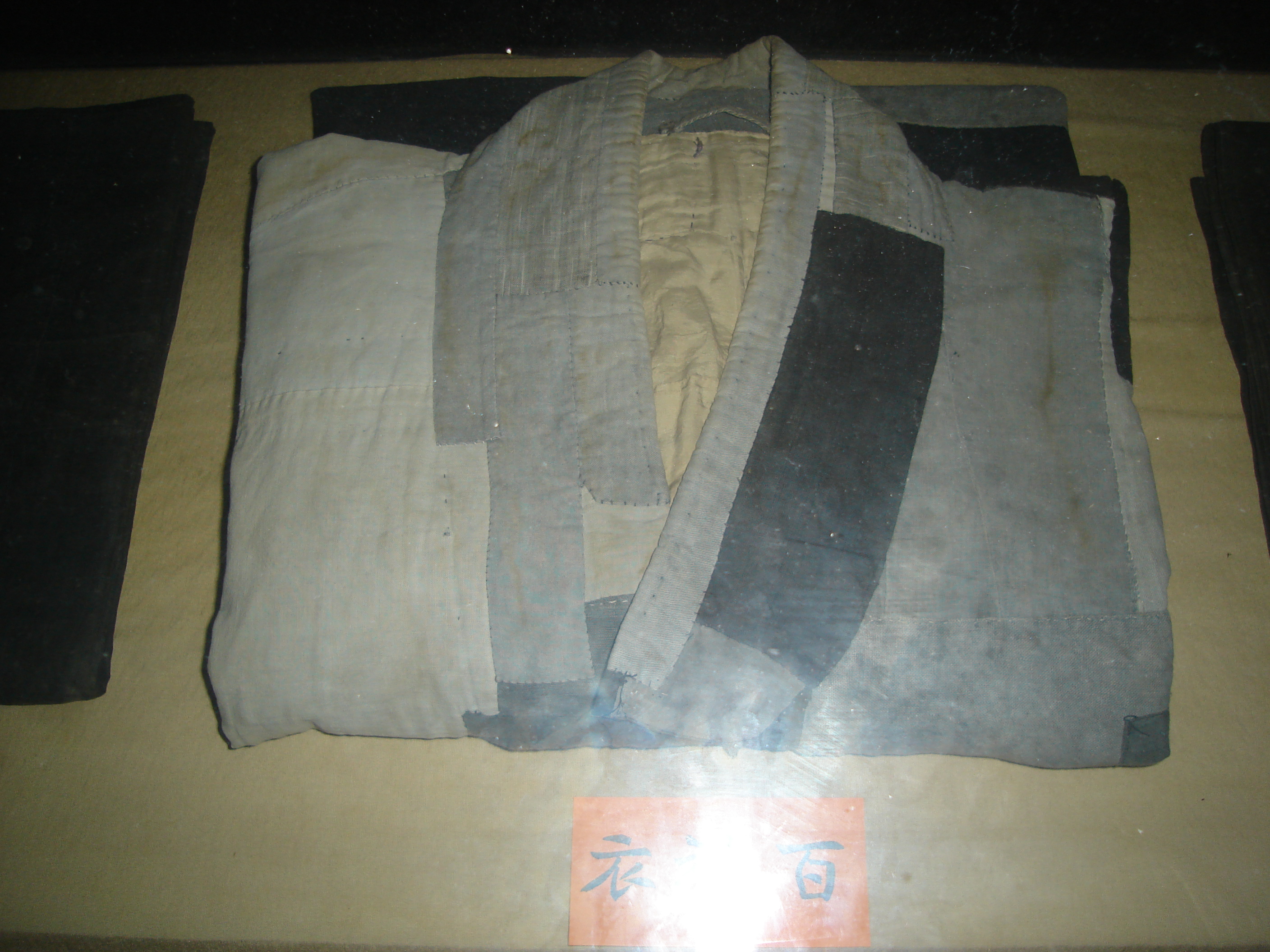
Master Empty Cloud’s old patched robe.
from the pain. However I had gone for the ultimate great test and must get through all of the 49 days somehow or I knew that I would find the humiliation unbearably terrible if I failed. There was to be no turning back for me. Whatever happened during the retreat I would not leave it. I had also carefully taken care of all my affairs before leaving England and had also been to my solicitor just before I left to make a new will, which I had left at home next to my shrine, before I flew to China. There was a large pile of logs to keep my girlfriend warm during the cold winter nights alone in our house until she would come to meet me in China after the retreat ended. I heard that Mr Wang had been given a verbal public humiliation for behaving the way he did, not just disturbing me but some others who had also experienced the great pleasure of sitting next or near to him. The Disciplinarian Master Guang San ordered him not to constantly gaze around the room or disturb the serious atmosphere. Later he made some friends, including myself; he seemed both likeable and intelligent. His practice improved notably and one day he was gone before I could get a photo of him to remind me or thank him for his teaching. After that, when somebody new came to sit next to me and shuffled it was different. The more they moved the stiller I became. The more agitated they seemed the more I relaxed. Later I was told by one or two people who had not yet learnt how to sit properly, that they did not like to sit next to me as I sat so still for so long (but it doesn’t really seem like that to me at all) as it made them feel self-conscious. I replied in my usual way that I still feel very much like a beginner. My foot was killing me, it stank, and there was a bad infection in between the small and second toe. I showed it to a retired doctor I knew, Thomas Chew, and he took me straight to the monastery pharmacy with its two part-time doctors, a retired dentist, who is now a monk, and the twenty year old Charles who spoke Mandarin, some Japanese and a lot of slang English. He had learnt folk medicine from his granny whom he claimed was a descendant of a doctor to some great Emperor; he wanted to go to Buddhist College in Beijing to ordain, but first he had to volunteer here for one year. They usually saw 4-5 patients a day: old monks with heart conditions, arthritis from living on the High Mountain, altitude sickness and one day someone had a hernia. Many patients had my problem: severe blisters from the running. They cleaned out all the puss and rotting skin from my wound and poured in antibiotic powder from a capsule. They held me down so I could not watch. They thought it was very funny and told me it was better ‘out than in’, laughing and joking in their Chinglish. There was no more fast running for me after this. I had once again to hobble in the slow lane around the edge of the hall, whilst the others ran around the middle for the rest of the retreat.
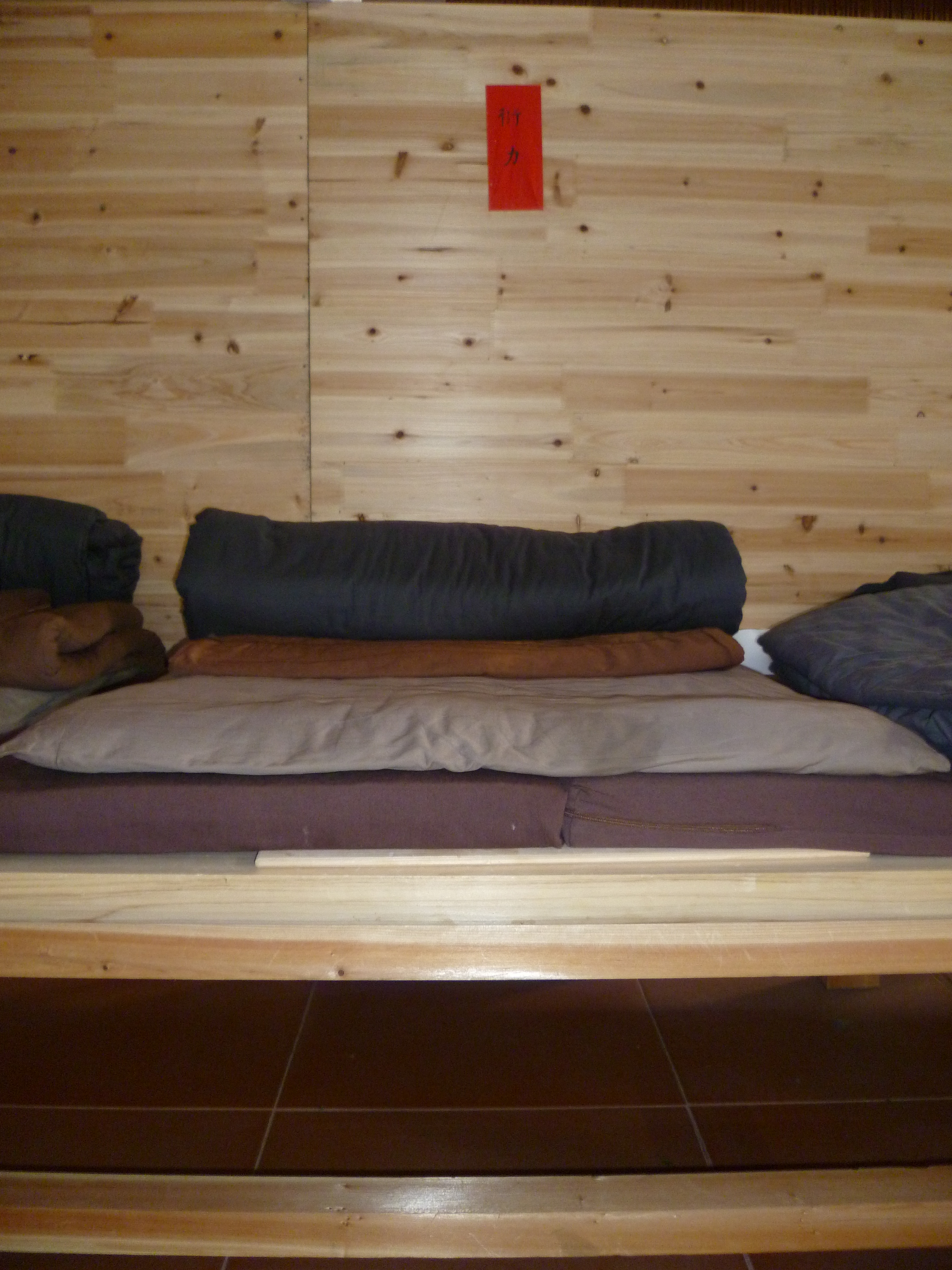
My seat for 49 days.
About the Meditation How did it feel to me? Of course there was false thinking, I can never stop it for long, but you can focus away from that and it just quietens down a lot naturally without engagement with the inner dialogue. The first two weeks saw a rapid diminishing of my normal day to day thought patterns. I neither forced them to stop nor followed them, I was simply aware when they were present and aware when they were not. I just developed my focus on the Hua Tou ‘Who is thinking of the Buddha?’ My practice method of Hau Tao 话头, or mind before thought meditation is like this: refining the breath until it becomes so fine it seems suspended but without force. Breathing deep into my stomach, feeling it fill and contract until normal consciousness just slips away. Then I am looking at a clear pure awareness Hua Tao or mind before thought, the one who hears the sounds of the world to which I do not react. From here I can begin to apply the question or doubt properly. The Gong Gan or Koan of the retreat for most people is ‘Who is thinking of the Buddha?’ (Some do Buddha recitation and others do breath counting.) I often became so fascinated and freed of self-concern that before I knew it the bell rang to signal the end of the sitting. Soon after I remembered the normal self and where I was. The reason for the Doubt is to go deeper than this surface or entry Samadhi state while holding the doubt lightly like the smoke going up from incense, but as steadily as a stone sinking to the bottom of an endlessly deep well. People commonly hallucinate or hear things (I heard bells like heavenly music on this retreat), have itching, bliss and ecstasy, or pain, arising of Bodhi Chitta etc. The method is to dismiss all of this as just head stuff, then be trained into the state of ‘mind before thought’ for longer periods. I just gently held this feeling of doubt as to what one’s ‘fundamental face’ really is, no matter how mindful or clear I had become. The doubt method stops practitioners from falling into a state of dullness. The doubt method is now generally considered harder but surer and quicker than silent illumination 默照 in China. When the bell rang at the end of a sitting, I took the rug off my legs and pulled out my shoes from under their bench and slipped into them. Walking off, I felt so light, just like flying, I hardly made any noise whilst walking. Just gazing gently straight ahead and inquired into who is walking, what is moving and continued to hold the Hua Tao or mind before thought. I began to intuit what we can never know with conventional language or habitual thinking. Usually, the longer the meditation the better the result but I could never be sure what would happen when I went to sit on the cushion. It’s tricky, subtle and unpredictable. The only way is just to keep on having to let go of everything again and again, developing an attitude of timeless patience and just be like ‘the dead guy’, not reacting to anything. Then, after letting go of Buddhism, the retreat and myself, I may only hold a single thread of harmonising doubt so subtle it is broken with a single thought or breath. Monday, December 31st. The cold had gone and it was mild and sunny and the birds sang. The sitting was better than ever and I was in the magic world of mind before thought, where I saw everything afresh as if for the first time. After lunch, I went as I often could to make three prostrations in the Empty Cloud memorial hall around the back of the monastery. Then I soon had to return to the Chan hall to drink strong green tea before the afternoon sitting. That evening, during the meditation one of the patrols made a mistake. He saw one guy making involuntary movements, circling around with his upper body. He raced over and hit the offender three times hard with the incense board. However he only had the authority at his rank to strike once. He was ordered to kneel before the Buddha in repentance for a long time. I know him – he is a good monk and is quiet and humble. Sitting next to the involuntary mover was a Russian man who came for nine days; he sat well and spoke fluent Mandarin. Afterwards he told me what had happened. He also told me about another guy who was making a lot of stomach noises but he thought that this was on purpose: strange things were happening in the Chan hall. A couple of guys looked like they had gone a bit crazy and there were a couple of near fights. The offenders were quickly moved apart, as I had been from Mr Wang The repentant patroller had seen me spending many sittings completely absorbed. He had seen me close up so he knew my experience. He and some of the others praised my skill in entering Chan absorption; they had never seen a westerner do this before. I overheard them talking about me, then one of them held my hand in a common understanding. We all laughed and smiled knowingly together.
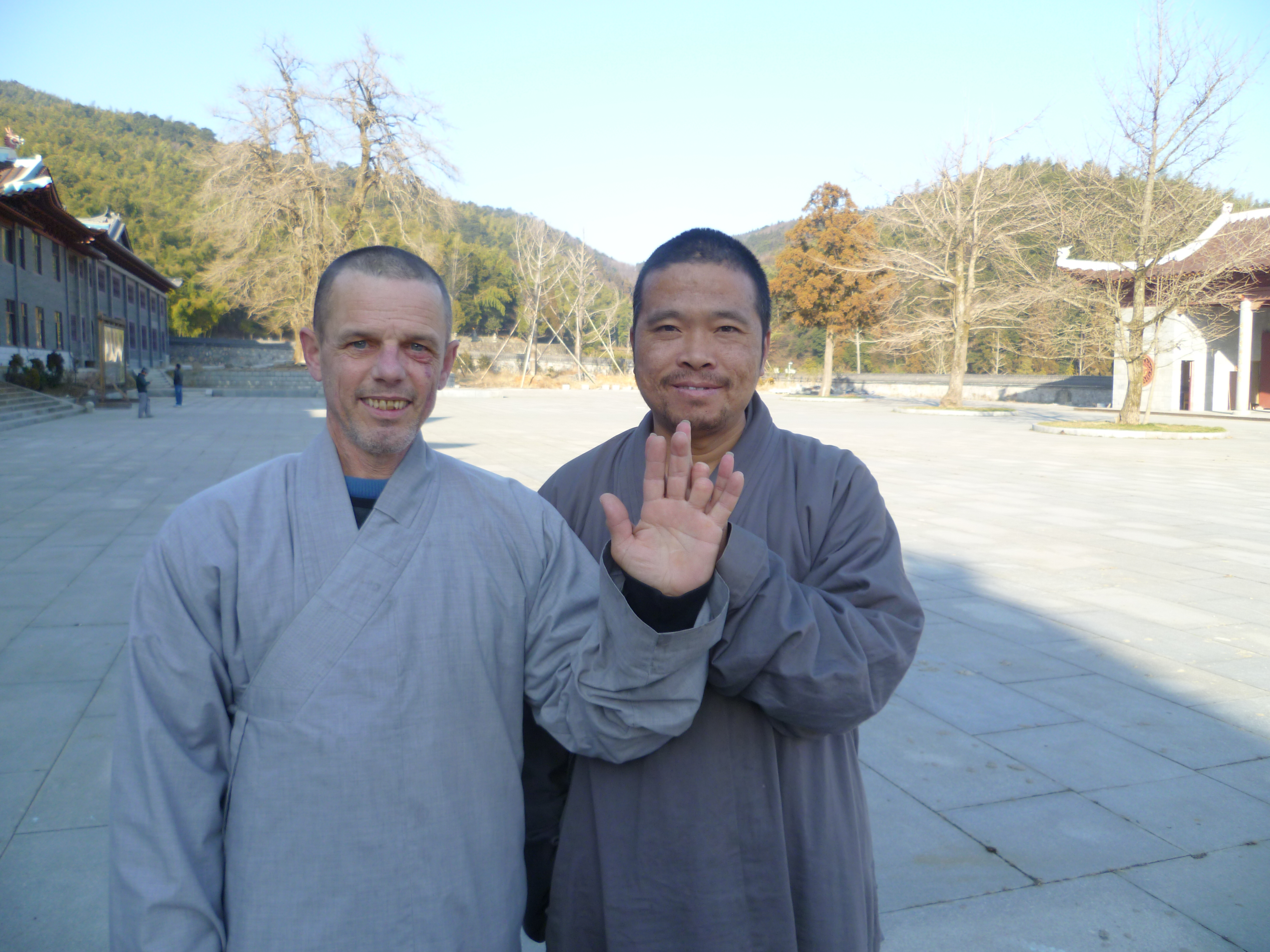
With, Chan Master Wu Xuan the Abbot of Kwan Yin Temple on the Zhung Nan Mountain nr Xian.
The blood-vomiting monk, Wu Xuan or ‘Awakened Declaration’, held the top seat as instructor. He had the room next to mine. He was from the Xian area, having lived as a hermit on a very remote part of the Chung Nan Mountain range. He had eaten very coarse food until his stomach gave him trouble and he vomited a lot of blood, hence my nickname for him. His seat was directly opposite mine in the meditation hall. I wanted to talk to him after the meditation finished for the afternoon break but he would just walk away fast from me, across the yard past the hall of the four Deva Kings towards our rooms. No matter how fast I tried to walk I could not catch up with him and then he just disappeared around the corner. But one day he slipped on the ice and I had my chance to catch up and talk. We became instant friends. I told him about my dream to visit the Lion Hut on the Chung Nan Mountain and said I had heard he lived near there. He invited me to stay in his nearby Kwan Yin Monastery when I go. During his highly animated talks he mentioned posture; he said he could tell how a student’s practice was just by looking at it. We had been sitting opposite each other and had a good idea where each of us was at. A couple of nights later he was standing outside his room having left his key inside. I offered him my bed for the night but another monk came with spare keys. None fitted though. I then got my credit card and he used it to spring the lock in an instant, looking triumphant at his achievement. The very next day he decided it was his turn to chase me across the yard. I had been sitting well and moved easily and at speed. I felt almost as if I was weightless and almost flying (this would sometimes last for about 20 minutes after a sitting), but he easily caught up with me and asked for my photo. To my surprise he then pulled out my left hand from my long sleeve and held his hand against it. We had the same second fingers missing, given as offerings to the Buddha, just the same as the other monk who had come with spare keys to his room. These extreme things are still practised in Chinese Buddhism today. Doctor Thomas Chew turned up and took the photos. Chan Master Wu Xuan asked about my infected foot. He laughingly told me he himself had seven blisters from the running. Living so closely with 200 monks was a very warm and tactile experience. They would often hold my hand. I enjoyed this even though it was something I would not do with a man in the west. But here everything was so different to my normal life. The clouds had appeared around us and they got into your upper lungs and hurt. Many people looked affected and a lot of Chinese medicine was put out for us on the tea table outside the Chan hall to use freely. During the 6th week, I was told to see the abbot; he had sent me three books on Empty Cloud for my website. I waited over one hour, drinking his tea and eating his fine snacks together with his assistant, but he was delayed. The next day I went back again to thank him for helping me get on the retreat. He asked me in Mandarin how I was finding it. There were big smiles. He was often out attending meetings during the retreat, but you certainly knew when he was around with his strong inspiring presence. He sometimes gave talks in the evening and sat together with us. He was constantly busy and in demand. You would see the many visitors that flocked to his temporary room (as his had burnt down). It was the last day. Time had passed so fast. The retreat didn’t seem long enough. I still hadn’t completed my task of personal transformation. I was still reactive but had an insight into the teaching that should stay with me for the rest of my life if I continue to work on it. That evening, during the last meditation most of those present went to kneel on the floor in front of the Buddha Rupa in repentance, and so many were kneeling almost directly facing me as I was sitting behind the Buddha statue. I was one of the few remaining sitters. It was a very humbling experience of the type you don’t easily forget. They all just knelt there so earnestly in their total desire to improve and transform themselves; they just wanted to share the Buddha’s pure mind and be free from greed, hate and delusion. Then the bell rang for the last evening and then we all together made three formal prostrations on the floor to the Buddha. I heard a few times from the monks during the retreat that we must love everybody. The serious training of the retreat was indeed harsh and brutal but the kind of Buddhism it makes is soft and gentle, warm, friendly and respectful. The next morning there was a short closing ceremony which included a length of rope. In case anybody falsely claimed enlightenment he would be tied and bound, then led out of the monastery, one of the ancient Chan customs. After breakfast we all assembled on the steps outside the hall of the four Deva Kings for group photos. The local Nanchang newspapers were there together with many other lay supporters. It took around one hour until everybody thought they had enough photos to remember the retreat with, then they all quietly slipped away. I left the monastery the next day. It was all over just like that.
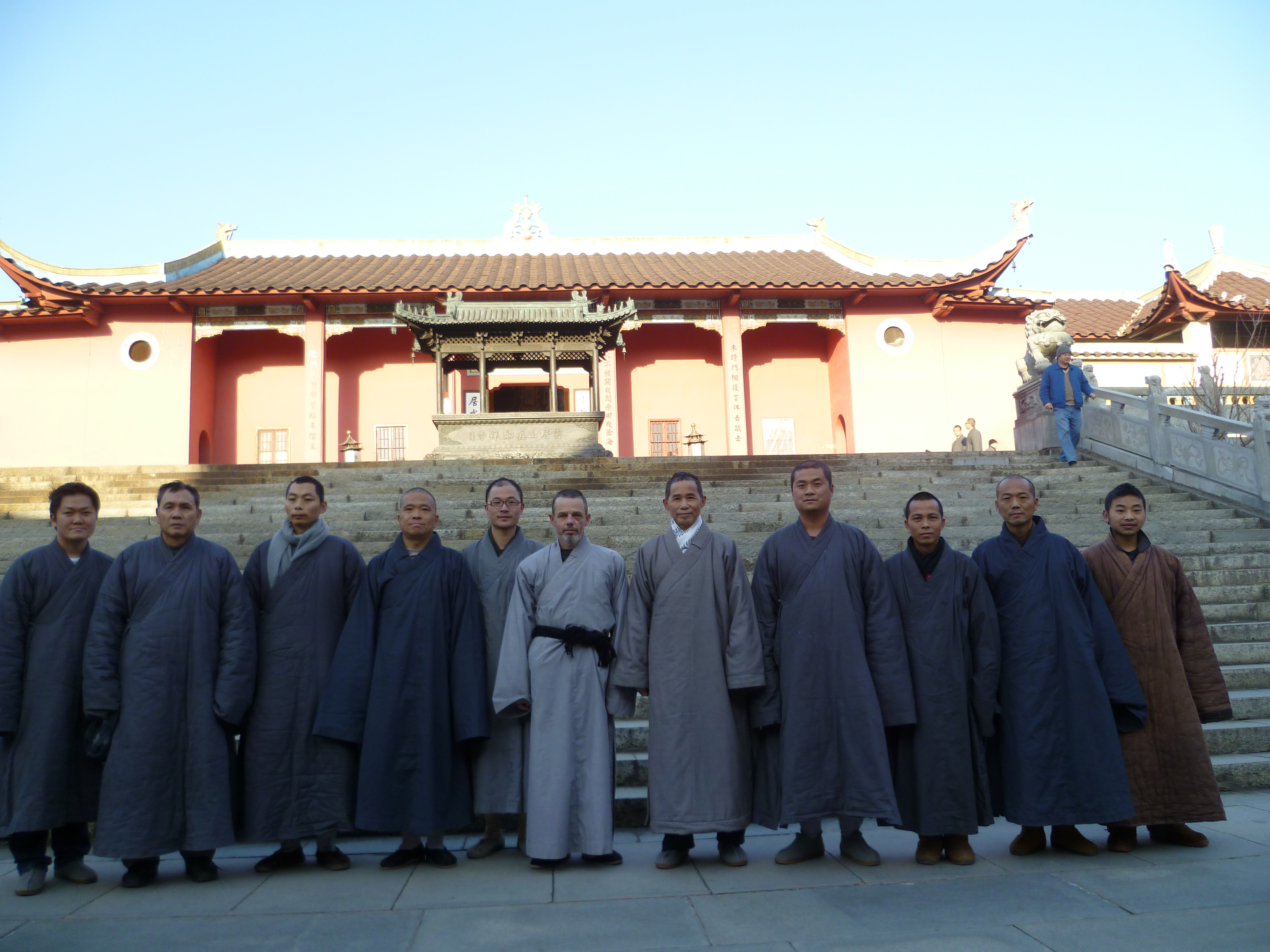
On the last day. 真如禅寺


