An hour later I had my first chance to join monks, seminarians and aspirant laymen in the East Chan Hall meditation session. We all had to wear the long grey robes and fast walk clockwise around the shrine.
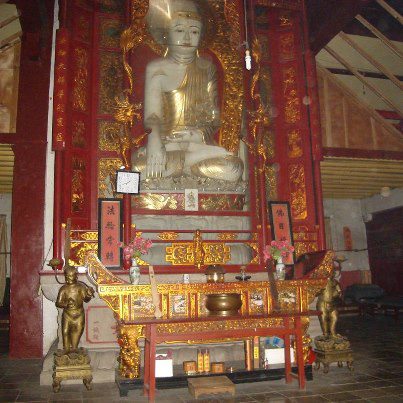
Inside the East Meditation hall.
After a few minutes we were shouted at to work harder on the Hua Tao and run faster (a sort of jog) then the wooden fish was struck and we found a bench to sit on. The door was firmly locked; nobody could now enter or leave. Everybody was expected to sit in full lotus for the whole hour; some could not and looked sadly tortured and in great discomfort, this is a process of training body and mind and a few will probably not make it and decide to leave. Some just slip into a deep state of meditation straight away and remain motionless and deeply calm. As the only westerner there I knew that I had around 50 pairs of eyes, curious to see my skill. The head monk even warned me that the sittings were always an hour or more; he soon knew that I had had good training and knew how to relax and settle into the discipline without a problem. I heard that they had an American fellow leave quickly the year before – it is a shame that he couldn’t endure longer and advance his training here. East Meditation Hall The head monk patrolled with his wooden sword hitting anybody asleep or in a strange position on the bench. It was a sort of game of cat and mouse, for as soon as they knew he was coming the meditation practitioners would straighten up, and as he passed they relaxed again. A couple of times I heard snoring! However he had the skill to walk around silently like a cat and often caught those clever ones out. They were not hit hard in this monastery that seems to be more in the Japanese or Korean culture, but just received a mild tap on the top of the arm muscle. Also, they do not have those big round Japanese cushions (zafus), but just use flat mats about half an inch thick to sit on. The best way is to sit with nothing under the bum, that way your legs do not go numb I promise you (after you’ve grown accustomed to it). At the end of the sitting, the hand bell was rang and we could freely wander out. As a lot of the others were curious about me I spent time every day answering questions. They were surprised that I had been practicing meditation for 40 years, as many of them were under 30 years old. They all tried their best English sentences on me and it was all very good natured and fun. They really made me feel part of this wonderful Buddhist family, the legacy of Master Empty Cloud; I was privileged in a way I had not expected when planning this pilgrimage. I went to afternoon chanting. It was like music from heaven as the atmosphere was so rarefied and with exquisite incense. The session lasted around one hour. The hall was full with around eighty people. Returning to my room I was approached by one of the managers, He Dong Fa Shih, who asked me to his room for tea. I asked if Sam could join us, he was happy and we all became good friends quickly. I left them to drink his rather poor coffee and went to the late afternoon meditation, it lasted for 90 minutes with no chance to move my legs, but in there, in that atmosphere it was a great chance to practice and a wonderful experience. As you get towards these longer sittings I find they start to become self-energising, after going through the pain barrier if it is necessary, so you can work very hard at the practice. As I came out He Dong was waiting for me, this was the first of a series of kidnaps and as the only Western exhibits available we were again taken to supper in a private house in the nearby village. Rice and local mountain vegetables similar to the monastery food were provided but more relaxed. We walked back, using his torch, past Bright Moon Lake to our rooms.
1 November
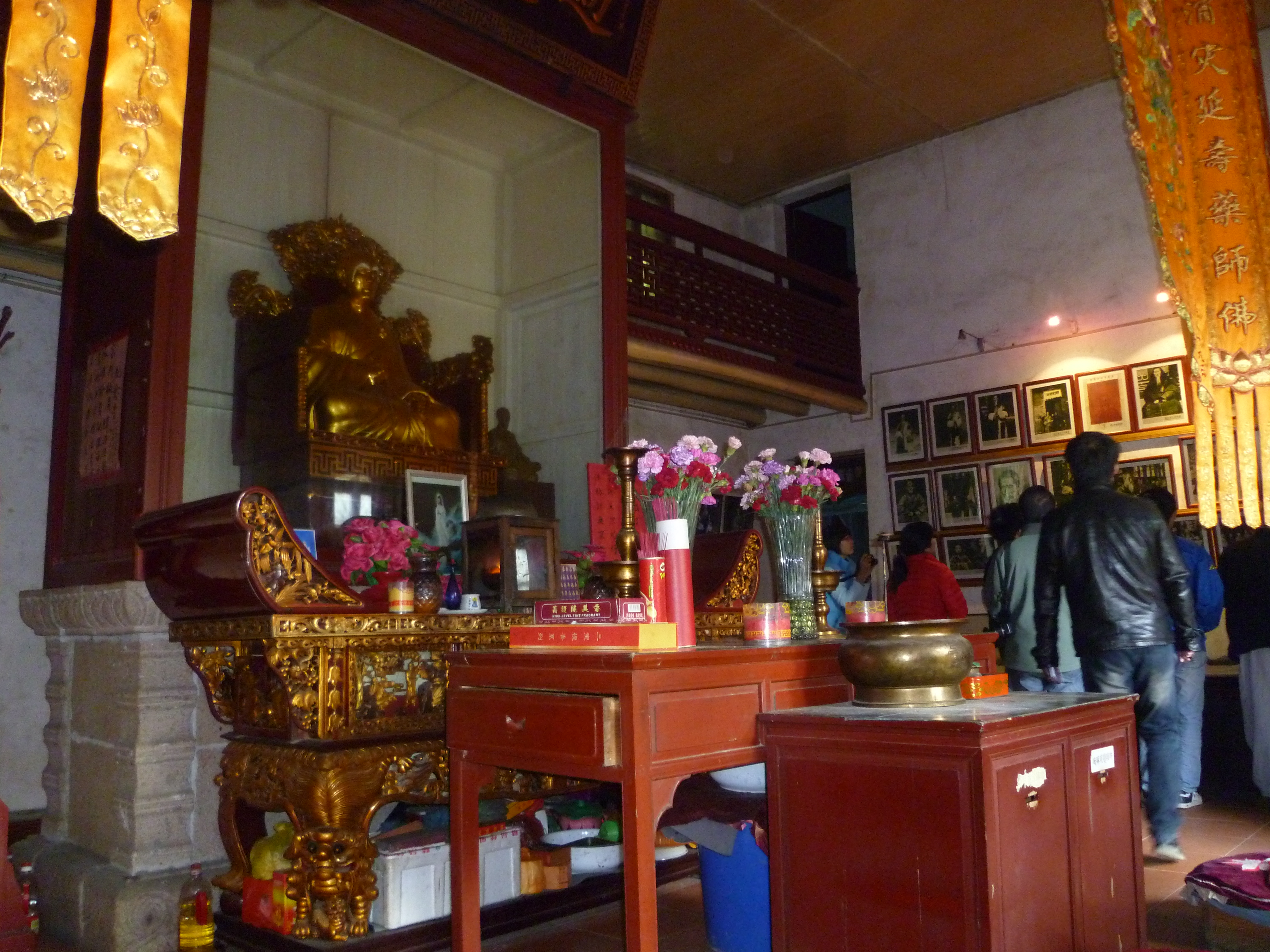
Inside The Memorial Hall.
Jet lag had passed and I had the first proper night’s sleep since arriving in China and it was much warmer that night. Another kidnaping was in progress; a trip to Dong Lin Si, the famous Pure Land Monastery not far away. Sam went with He Dong, some monks and the three girls from Shanghai. I refused the invitation and returned to the meditation hall and spent several periods in and around the Empty Cloud Memorial Hall, watching with interest the pilgrim visitors as they arrived to see what was left of the Old Master. In one moment I was sitting in meditation under a tree outside and when I opened my eyes there were a group of people prostrating to me! I moved to a quieter place in a bamboo grove around the back, returning later to the memorial hall after doing some prostrations. Other pilgrims had arrived and asked me to pose for photos with them, they were very devout Buddhists – monks, nuns and lay people, and it was a very happy occasion. My Mandarin was almost good enough to deal with the many strong accents and I could engage in basic conversation. Builders were replacing the wooden eaves on the roof, changing some of the metal roof tiles (they cost £3.50 each) before the strong winter winds came. There was a lot of hammering and cigarette butts on the floor, the air smelt of nicotine as well as incense. At the afternoon sitting the hall was filled with many visiting monks. Some had to sit on mats on the floor as there were not enough benches. Discipline was much stronger; obviously they wanted to put on a good show for the visitors. After lunch I went with some monks to collect firewood from the forest at the back of the monastery for the kitchen’s cooking fuel. Novice monk, Venerable Leung Yi after collecting firewood That evening the one and a half hour mediation period was half empty, the visitors and some of the residents had gone, there was a lot of fidgeting going on, not like earlier in the day! I went to the dining hall at 7.30pm for a bowl of very hot noodles, and then went quietly back to my room to take in all of this adventure.
2 November
At lunch time Sam, the three Chinese girls from Shanghai, and the manager monk He Dong and I went to eat again in the same private house, just outside the monastery in the village. Afterwards we went to the Xu Yun sharia Pagoda (relic tower), it was also just outside the main monastery gate. It was built by Master Yi Cheng the retired abbot of Chen Ru Si in 1983. He is now the chairman of the Buddhist Association of China and was a student of Xu Yun, becoming abbot after him. Then we drove down the mountain to West Sea, to the place where Master Empty Cloud’s ashes were mixed with flower and sugar, to be formed into seven balls and fed to the fish there. On the way we got a nice smile from a ‘lady boy’ from Thailand who was passing on a sampan. After a boat trip on the lake, we were taken to an orange grove and once there met a friend of He Dong’s who was able to speak to me in Japanese. He let us wander around the orange grove picking some oranges to take back to the monastery. We were then treated to a free meal (free to us because no-one would allow us to pay) in a local restaurant and eventually driven back up the mountain road in the dark. In the car headlights we saw a wild mountain cat with a fresh kill in its mouth crossing the road and dragging ‘supper’ across too, soon after we saw a large venomous snake with a bite, we were told, like a morphine dose. We were staying on a remote high mountain with plenty of wild creatures around us, but we walked the last part unafraid around Bright Moon Lake under a bright quarter moon. Samantha and I had decided to extend our stay for the rest of our time in China declining.
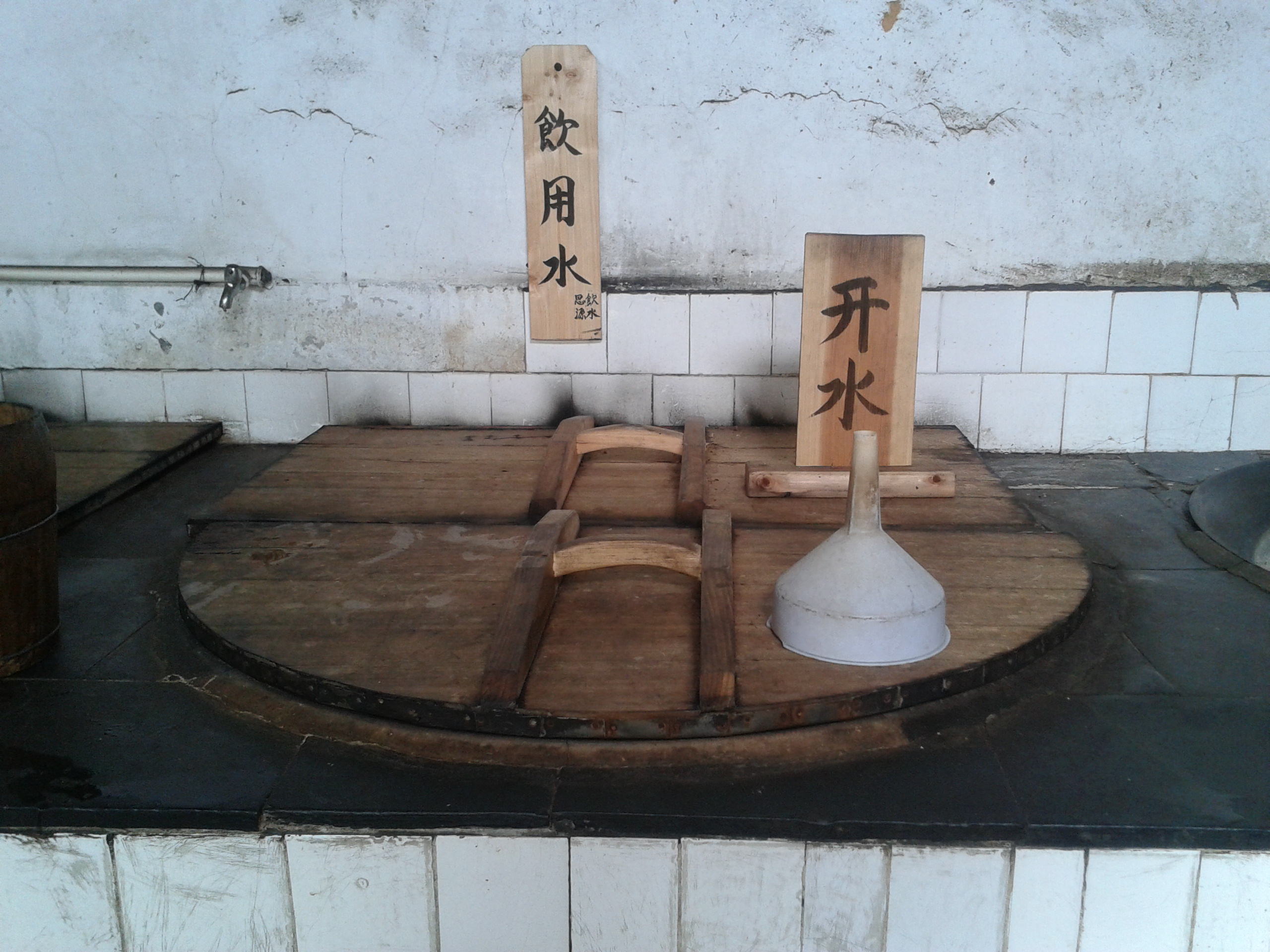
The hot water
invitations to go elsewhere (more potential kidnapping!). He Dong said he could arrange it for us. I went to the kitchen to get a large flask of hot water to wash with (there are no baths there, only dirty disused showers that do heat up in the afternoon sun for a short while). While in the kitchen I was fascinated to watch them making tofu and pressing it into firm blocks in large wooden trays. The food in this place was special. The monk’s diet was clean and free of chemicals and was home grown including the rice. This Sangha farm was restarted by Master Xu Yun and tea bushes that he personally planted still grow there today. The food is detoxifying because it is pure, just as in the macrobiotic way of eating. It is also Vegan with quite a lot of ginger and chillies with absolutely no garlic, onions or leeks. It was served piping hot and plentiful, delivered to the bowl at a fast pace. The monks eat very quickly and it is sometimes difficult to keep up when it is so hot and spicy. You have to let go of a lot of mind stuff that you normally would take into a restaurant. The way to pay the bill there is to empty and brighten your mind, you “just eat”.
3 November
Master He Dong, one of the manager monks told me that I had been given permission to enter the West Chan Meditation Hall reserved for advanced practitioners. Everybody in this place has their own way of interpreting the rules and I went in and was then told to get out. Then a few minutes later I was again invited in, and then frogmarched out by the monk in charge, who said only monks could enter. Talking to He Dong I learnt that some monks only slept 4 hours and some could sit all night and not lie down to sleep, also there were a few hermits living on the mountain, in huts or in small groups. I was told how strict the rules were here even by Chinese standards. No computers were allowed, Internet phones could not get a signal and any monk or ‘home leaver’ caught smoking was asked to leave. The monks are so respected locally they need no money to travel and can eat almost anywhere. They each get about £30 a month stipends and I noticed many of the monks refused the red envelopes with money donations inside. Electricity has been connected for only the past 10 years and a telephone line for five years. There is no TV or radio. Abbot Chen Wen is 40 years old, he left home aged 19. He is unusual looking and has a compassionate but strong presence, he is strict with his young monks. We were kidnapped by the abbot’s assistant, and taken to Taiwanese monk Jian Quang, who was staying for a few days in a house in the village. After telling us what a committed vegetarian he was and that other schools of Buddhism had made a mistake on this, we agreed, to be then told to do many prostrations to open our spines and make it easier to sit full lotus for long periods. Many ‘Home Leavers’ in China talk like this. He took us to a village at the foot of the mountain where we had lunch.
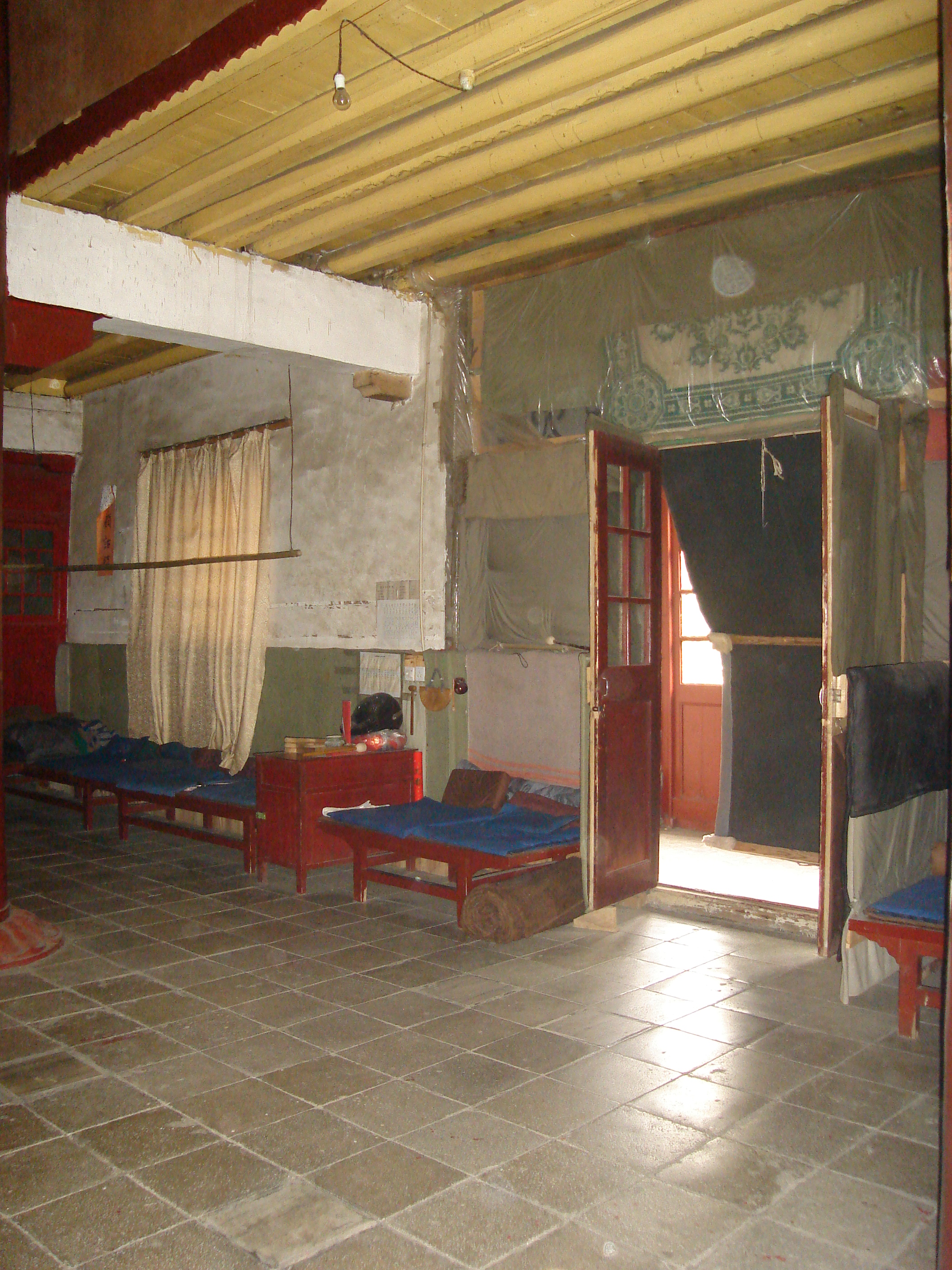
Inside the east meditation hall.
with the local doctor in his house/surgery with rice and vegetables grown in his own garden and we were made very welcome. It was one of the best but most simple meals I had ever eaten. Inside the Chinese doctor’s house Afterwards, we went for a walk with the abbot’s assistant Yi Jue. After walking uphill for an hour and a half we asked how much further it was to get back to Chen Ru Si, laughing, he pointed to the furthest peak miles away. We had no water, food, or even a hat and the sun was blazing and it was then around 3.30pm. We doubted if we could make the dangerous climb in the dark with no torches and asked him to turn back. Limping back down the mountain he arranged us a lift using his mobile phone. An hour later we got in the back of a forestry truck which drove us back up the mountain and were asked endless questions about our life in England, how long it had taken us to travel from London and about everything else that we could manage with my poor Mandarin.
4 November
Every day started to become more usual and familiar, it started to look like this:
| Time | Activity |
|---|---|
| 3.45am | Morning board, bell chant followed by morning drumming |
| 4.15 – 5.30 | Morning chanting |
| 6.00 – 6.30 | Breakfast |
| 7.15 – 7.30 | Running meditation |
| 7.30 – 8.30 | Sitting meditation |
| Work period | |
| Rest | |
| 11.30 – 11.30 | Lunch |
| 12.15 – 1.30 | Running and sitting meditation |
| 2.40 – 3.40 | Afternoon chanting |
| Work period | |
| Rest | |
| 5.30 – 5.45 | Running meditation |
| 5.45 – 7.15 | Sitting meditation |
| 7.30 | Very hot noodles in broth – informal meal |
| 8.15 – 9.00 | running and sitting meditation |


