Abbot at South Flower Monastery
My Ninety-Fifth Year 1934 -1935
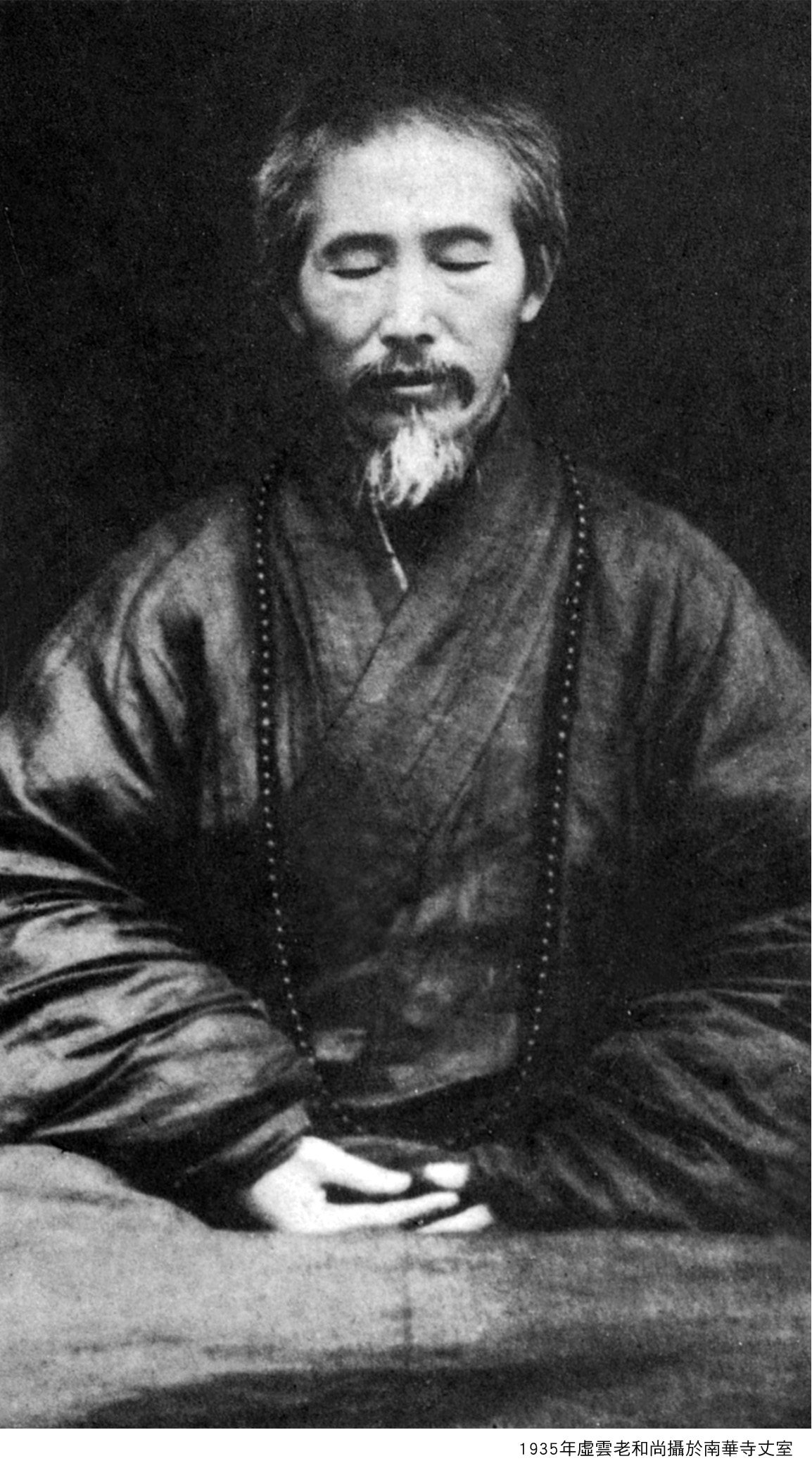
1935 南花禅寺广东 South Flower Chan Monastery
That spring I invited Master Ci Zhou to run the Precept College and to help improve it. Then, one evening in February, I had a dream that was not quite a dream. The sixth patriarch of Chan (Able Capable or Chan Master Hui Neng) said to me, ‘It is time to go back’. I talked about this to Master Contemplate Root or Guan Ben the next morning, I thought my life might soon come to an end. He tried to comfort me with a few words. Then again, in April, I had another vivid dream when the patriarch asked me twice to go back and this surprised me. Then, quite soon the local Guangdong government telegraphed me asking me to restore and run the monastery of the sixth patriarch. The last major repairs there had been done by Master Han Shan (1546 – 1623). Some minor renovation had been undertaken from November 1933 to October 1934 by General Li Hanyun of the north Guangdong army, but it was now semi-derelict. So I set off for the monastery. (The Master arrived from Drum Mountain to the Southern Flower Monastery on Sep 2nd,1934, together with the district officials. It was the sixth patriarch’s birthday and about ten thousand local people had also come to offer incense. It was actually more of a carnival atmosphere) Arriving at the Cao Xi gate the Master pointed his staff towards it and chanted: ‘Here at Cao Xi a dream has come true. A poor man has come back from far away. To what is and what is not give no more thought – it’s still even wrong to call it the bright mirror. After the midnight transmission of the robe and bowl on Yellow Plum mountain, the Chan light has shone brightly for hundreds of years. Who will carry on the lineage of the descendants’ house? One lamp after another reveals a majestic spirituality.’ The Master arrived at the Precious Wood monastery gate. He pointed his staff towards it and chanted: ‘The Cao Xi road is quite clear here. Precious Wood’s gate swings wide open. Students of the ten directions all come here on pilgrimage. Reaching this place of transcendental bliss, the pure emptiness is dust free. There is no center or circumference to the Dharma realm. This Dharma door contains the wonder of all the others.’ The Master entered the Matriea hall and chanted: ‘Loud roar of laughter from the big belly – all worlds rain thousands of white lotus flowers. His cloth bag is as large as the universe. Later, teaching under the dragon tree he will succeed the Buddha.’ The Master entered the Wei Tou shrine and chanted: ‘You come as a youth to answer all needs. With majestic majesty you defeat demons. Hail, with all ears hear the Vulture Peak sermon. To the protector of the Dharma, fiery general.’ (The Master prostrated in front of the statue.) The Master entered the fifth Patriarch’s hall and chanted: ‘This transmission from west to east, a flower blossoming with five petals, Northern Xui and Southern Neng sprout leaves and branches everywhere.’ (The master prostrated to the statue.) The Master entered the sixth Patriarch’s hall and chanted: ‘Every year on September 2nd, there are the tracks of birds in the sky. Despite not hiding in the universe, even Li Lou could not perceive them. How can we ever know?’ Burning incense, he carried on, ‘But this is pointed out clearly here today.’ The Master arrived at the shrine to Han Shan, holding incense and chanted: ‘In the land there was no rival, but now Gu Shan comes. Sometimes remembering, one repents restlessness – what restlessness?’ Calling his students, the master went on, ‘Two clay bullocks struggle to stride into the ocean. My heart is full of sorrow every time I offer incense.’ Offering the incense, he went on, ‘It is De Ching today and before it was De Ching. Form does not alter when past and present converge. With good and bad the Dharma prospers and declines. It has never stopped living in the grass and wood.’ (The master prostrated in front of the statue.) The Master entered the main hall, held incense and chanted: ‘Lord Buddha and Saha’s teacher rightly taught the uncreated. Dharma is profound and wonderful, but who is a Buddha and who is a living being?’ (The Master then prostrated to the Buddha statue.) The Master entered the Abbot’s quarters and chanted: ‘I now enter the room of the late virtuous one. Climbing up on to the patriarch’s seat whilst firmly holding a horizontal sword, and giving the correct supreme command. Here the ancestors and patriarchs proclaimed the Dharma to help men. I, this unworthy man, come here today, to do what?’ Snapping his fingers three times he went on, ‘Three finger snaps perfect 80,000 Dharma doors, ensuring direct entry to the Tathagatha state.’ The Master entered the Dharma hall and, chanting, pointed his staff at the seat: ‘This precious seat’s eminence was passed down between sages. Everywhere is without hindrance. All Dharma doors are profound when the head is raised in the sun. Cut off and dismissed is the pressure of grasping. Even copper pupils in iron eyes cannot reach it if they try to look. This mountain monk’s revival is nothing special. If you want to see all the way, you must climb to the top.’ The Master pointed his staff at the seat and chanted, ‘Let us climb up!’ The Master got up on to the seat, holding incense and chanted: ‘These incense sticks do not come down from heaven or from the earth. Smoking in the incense burner is my offering to the Shakyamuni Buddha and to all the Buddhas and Bodhisattvas, offered to all of the past sages, the past patriarchs of India and China; also to Arya Jnanabhaisajy, this monastery’s founder and to the sixth patriarch, and also to all of the past masters of this seat. May the Buddha’s sun shine more brilliantly and the Dharma wheels turn forever.’ The Master took his seat and arranged his robes, and then the leading monk chanted: ‘All dragons and elephants that have come together for the feast should look into the true meaning.’ Then the Master, holding his staff said, ‘In this great matter, clearly there is not even a single Dharma. Causes and conditions have not run their course. I have come now that Master Han Shan has gone. This monastery’s renovation will depend on me. It was founded by Arya Janabhaisajya who foretold that, 170 years after him, a great master would teach here (Hui Neng, the sixth patriarch) and “as many people as the trees in the woods would become enlightened” was his prediction. That is why it is called “Precious Wood” (the original name before Southern Flower). That was a few hundred years ago and countless people have awakened here. The monastery has experienced times of prosperity and times of decline. In the Ming dynasty, Master Han Shan restored both the monastery and the Chan sect. That was over three hundred years ago. Since then it has declined terribly as there was no successor. ‘Whilst at Drum Mountain I dreamt three times that the patriarch called me back here. The officials and Buddhists who sponsored the renovation sent people to Drum Mountain to invite me to become abbot here. Because of their sincerity I felt compelled to accept and now take the seat. I am ashamed of my shallow wisdom and poor virtue and do not know how the management of this monastery works. So I ask you all to help so that the withered branch will be drenched in sweet dew and compassion will ‘cover the house in fire’. Together, we will do our best to restore the Patriarch’s monastery. About trying to restore it, what am I now doing?’ The Master bowed to the right and the left and said: ‘Under my robe’s corners, the four Deva Kings stand.’ The Master then got down from the seat. In the winter the Dharma protectors requested me to transmit the precepts. Because some buildings had already collapsed and the dormitories were no longer usable, we built thatched bamboo huts for a few hundred guests. A large number of officials and privileged families attended, wanting to become my students. On November 17th, a tiger walked in just as we were transmitting the Bodhisattva precepts. Everybody was scared but I spoke to this tiger, also offering him the precepts. He calmed down and then left.
My Ninety-Sixth Year 1935 -1936
General Li Hanyun was transferred to the east that spring. Losing his support meant more problems with the renovation. Then I had an invitation from the Donghua hospital organisation in Hong Kong to go and hold ceremonies for the deceased. At Dong Lin and Jue Yuan we set up shrines. Afterwards I went back to Drum Mountain to hand in my resignation, passing the job of abbot to master Zong Hui. Then, after returning to South Flower Monastery, I had the sixth patriarch’s shrine restored together with the shrine to Kuan Yin Bodhisattva as well as some dormitories. That winter three withered cedar trees planted in the Sung dynasty (960 -1279) suddenly sprang into leaf. Master Contemplating Root made up a song about it and it was carved on to a stone stele by my editor. (Chen Xuelu)
My Ninety-Seventh Year 1936 -1937
That spring, after we had transmitted the precepts at South Flower monastery, the renovation was about finished. Then we had a series of high profile visits: the president, a cabinet minister and General Jiang Gaishek. The politicians donated money to rebuild the main hall, whilst the general donated money to move the stream at the front of the monastery. The money was not needed here however as the Dharma protectors did the job for us. (note; Originally, the stream was 1,400 feet from the monastery. As it needed dredging so badly it had altered course and now flowed near the monastery. To redirect it would need 3,000 hired men and a lot of money. On July 20th there was a thunderstorm that lasted all night long. The banks burst the next morning, changing the course of the stream to just where we wanted it to be.)
(note; Lin Kuokeng, from the locally stationed army, bought a white fox to Southern Flower monastery to be set free. The Master gave the fox the precepts, explaining them to him. Then he was taken up on the mountain and set free, but he returned to the monastery where he lived like a pet dog. He used to sit with the Master when he meditated.)
My Ninety-Eighth Year 1937 – 1938
That spring, after the transmission of precepts, I received an invitation from the Buddhist Association in Guangdong. There I lectured on the Sutras and meet Tibetan Lamas with their students. I was then asked by Buddhists from Buddha or Fu Mountain’s nearby to inaugurate a new stupa at People Longevity or Ren Shou monastery. Afterwards I went back to South Flower or Nan Hua Monastery to organise the building restoration.
My Ninety-Ninth Year 1938 – 1939
(note; The second world war began) That spring, the precept transmission over, I went to Canton to lecture on the Sutras and then on to Hong Kong to lead the Great Compassion ceremony at East Wood or Dong Lin and Jue Yuan temples. Then I went back to South Flower monastery.
My Hundredth Year 1939 – 1940
That spring we transmitted the precepts. As many people had travelled down south because of the war with the Japanese, and some came to stay at the monastery. Since there were so many civilian and military casualties, I suggested we do two hours every day of dedicated practice for peace and for the dead. Also, I asked everybody to help to save money by eating less, so we saved up in order to give it all away. This was welcomed and achieved.
My Hundred and First Year 1940 – 1941
Canton fell to the Japanese army just after the transmission of precepts that spring. The government and army offices relocated to Qujiang. Many of the province’s monks also went there. I had the Great Mirror or Da Jian monastery repaired and used it as an extension of the South Flower monastery to receive guests. I also got the Moon Flower or Yue Hua Monastery repaired for the same reason.
My Hundred and Second Year 1941 – 1942
After the transmission of precepts that spring, I gave $200,000 to the local government. I had received these donations over the last two years in order to aid the famine in Qijiang. In the autumn I was elected president of the Guangdong Buddhist association, which had also relocated to Qijiang with Upasika Zhang Lian as vice president.
My Hundred and Third Year 1942 – 1943
That spring, as we transmitted the precepts, a tree spirit came from a nearby tree in which it lived to receive precepts. This unusual event was recorded by Master Contemplating Root or Gwan Ben: ‘A monk arrived after we had the transmission ceremony. He told us that he was from Qujiang, was named Zhang, aged 34, and was unable to find a master to shave his head. Asked if he had the ceremonial robes and other things he answered that he did not have these things so he was given them as he was so sincere and straightforward. We gave him the Dharma name of Tolerating Insult or Zhang Yu. He worked hard at cleaning the monastery before the ceremony and did not join in idle gossip as he was a reserved person. Entering the precept hall he kept all the rules to perfection, but after the transmission he disappeared. The robe and certificate were stored in the precept hall and we all soon forgot about him. The next year, just before the usual precept ceremony, I had a dream in which the monk asked for his certificate. I then asked where he went after the ceremony. In reply he said that he lived with the earth god and had gone nowhere so to send him his certificate. So it was burned.’ That autumn we renovated the Inexhaustible or Wu Jin nunnery to accept all of the nuns arriving in Qujiang. The Great Mirror monastery was now finished but there was still some work left to do at the South Flower monastery. I also still had to advise Drum Mountain on various matters so I was continually busy. We also had to tolerate the Japanese air force bombers flying over us every day. (note; Chen Xuelu says here: ‘After the Japanese took over Canton, the local government knew that the new wartime center was now at Qujiang. The Japanese military knew that high army commanders and government ministers frequently met at the South Flower monastery. (They could see their cars parked there from the air.) On July 7th, eight bombers came hovering over and circled around the monastery. The Master knew what they were intending to do so he sent the monks to their dormitories. He sent the other ministers and army personnel to the sixth patriarch’s hall whilst he went alone into the main hall. There he burned incense and sat in meditation. A large bomb was dropped by a plane but missed the monastery and landed near the stream in a wooded area. Returning, the bombers were circling the monastery when suddenly two of them collided and crash-landed at Ma Ba, ten Chinese miles away (three English miles), killing the crews and destroying the planes. Afterwards the Japanese avoided flying over the monastery on their way to bomb other areas.)
In November, President Li Shen sent Upasikas Chu Yingguang and Zhang Lilien to see me on behalf of the government. They carried an invitation for me to attend a prayer meeting in Chongquing, the wartime capital. Leaving South Flower monastery on July 6th, I went to Hunan, to Heng Mountain where Upasika Xu Gaozhu met me on behalf of Marshall Li Jishen, to take me on to Guilin. Then I went to Yue Ya mountain. There, many Buddhists requested that I become their Master. Then, arriving at Guizhou and stopping at Quin Ming Monastery with Master Precious Ray or Quang Miao, he requested I give a Dharma lecture. Back in Chongquing, I was met by government officials and people who were helping with the monasteries and the organizer of the prayer meeting, Upasika Dai. I also meet the President Lin Shen. Arrangements were made for two prayer meetings at the Ci Yun and Hua Yan monasteries.
My Hundred and Fourth Year 1943 – 1944
In January, I conducted those ceremonies to help the whole country, finishing them on the 26th. Then I was continually invited to vegetarian banquets by President Lin Shen, General Jiang Gaishek and others. General Jiang Gaishek asked me many detailed questions about the Dharma. I wrote him a letter of explanation afterwards. My attendant, Wei Yun, recorded the lectures I gave at Ci Yun and Hua Yan monasteries. Then, in March I returned to Southern Flower Monastery. I wished to construct a stupa to keep the dead disciples’ ashes in. When we dug the footings, four empty coffins were discovered, each measuring sixteen feet long. They had square black eight inch tiles on them, decorated with pictures of birds and animals. In June we opened the precept college for novice monks and then we started a free school for the local children. That winter we finished constructing the stupa.


