PART 2
The Cloud Gate incident
Masters 113th Year 1951 – 52
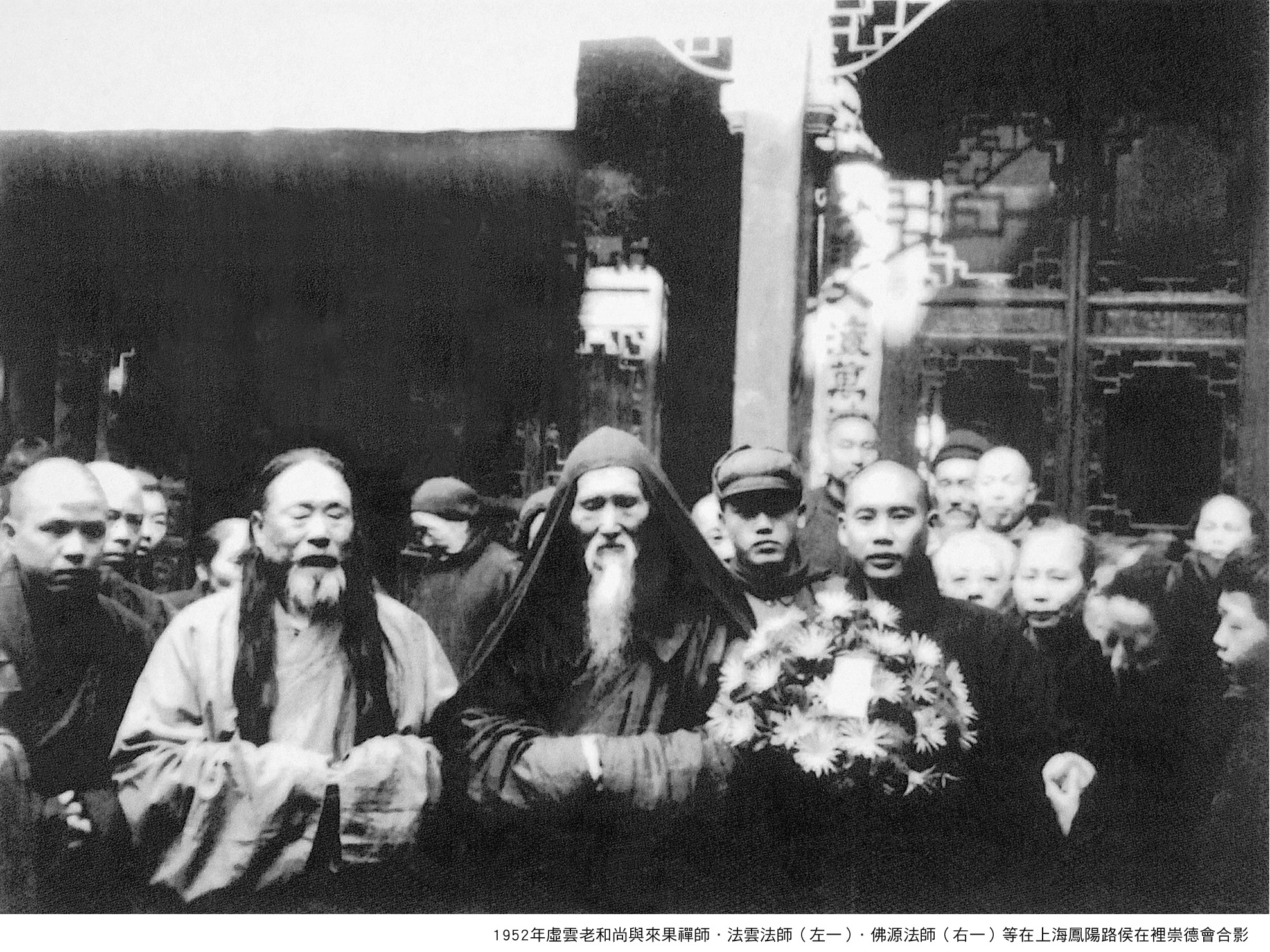
1952 上海 Shanghai.
That spring, after the winter meditation retreat, more than 120 monks, nuns and male and female lay Buddhists were living at the Cloud Gate Monastery. It was the time for the transmission of the Buddha’s precepts. Rumors had been going around locally saying that the Buddhists were rich and had gold and money hidden. They said that the top roof beams at South Flower and Cloud Gate were made of gold. There was also a rumor that there was a radio transmitter there together with guns and ammunition. On February 24th, suddenly the incense lamp fell to the floor in front of the Buddha statue in the main hall. A monk reported this to the Master who said that something would happen soon. Over a hundred members of a branch of Guangdong police force then arrived in trucks. They set up a machine gun on each side of the main entrance, so taking control of Cloud Gate monastery. Storming in, they frogmarched the Master to the abbot’s hall and imprisoned him. They then locked up the monks in the Dharma and meditation halls. They began a fingertip search and nothing was left unturned. They started from the top roof tiles and searched all the way down until they made some monks dig below the ground. The monks thought they were digging their own graves. On the third day, after finding nothing they escorted away the superintendent Bright Rays or Ming Kong together with four other senior monks.
Next they gathered all documents: these included the Master’s transmission certificates, poems and a commentary on the Surangama Sutra which was the only book the Master ever wrote. They took them all away and they were lost forever. These things were all in the monastery because it had been thought of as a safe place to keep them from the Japanese occupying army and others. The Master’s editor had been asked to take care of them. They then started making accusations against the whole community. Twenty-six monks were arrested and badly beaten to try to get them to tell where the money and guns were hidden. They all said that they had no knowledge of either guns or of any money. The monk Precious Cloud or Miao Yun was beaten to death, he was one of the Master’s closest disciples. The monks Enlightened Cloud or Wu Yun and Ti Zhu had their arms broken whilst being interrogated and a few other monks just disappeared. So, after a useless search, causing such terrible damage to the new buildings, and terrible injuries to the monks, the thugs turned there attention on Grand Master Empty Cloud himself. On March 3rd the Master was taken to a room where the windows and doors were sealed up. For three days he was left with no food, water or toilet. There was only one small lamp in the room. Then suddenly, ten men barged in and shouted at the Master to hand over the gold and guns. He replied that there were none so they beat him with wooden sticks first and then they used metal bars, breaking his ribs and nose until his head and face poured with blood. They kept interrogating him but, closing his eyes, he slipped away from them into deep meditation where they could no longer reach him. He was beaten four times that day, then thrown on the ground and left for dead. Soon after that they left and then the Master’s attendants carried him on to a bed and helped him to sit in a formal meditation posture. Two days later the torturers returned. When they saw him sitting peacefully in meditation they became enraged. They again beat him with wooden sticks and trampled him on the floor with their heavy leather boots. The Master lay there with blood pouring once again from his head. Thinking that he had died, they left laughing. That evening Master Fo Yuan came in with others & found the master suspended from the eves bound with a rope, the master was helped down and once more helped in to a meditation posture. Ten days after the start of his imprisonment and torture the Master lay down on his right side, like the Buddha when he died. He remained motionless for 24 hours. An attendant put a lamp wick to his nose to detect breathing but there was none; the master seemed to be dead. But his face and skin were still fresh, and his body was still warm as if alive. The next morning the attendants heard weak groans. Helping him up, they heard how he thought he had been in Samadhi for a few minutes, but they told him it had been several days. He told the monk Dharma Vow or Fa Yuan to take some notes but to keep them secret. He then told of his experience whilst in Samadhi:
The masters own words here; “I had a vision that I went to a Buddhist heaven more beautiful than anything on earth. On a throne was Maitreya Buddha teaching to a large group. Over ten of my late friends were there; they had been the abbots of Buddhist monasteries, or other famous masters. I put the palms of my hands together as they showed me the third seat on the west side which was empty and invited me to sit down. Ananda (the Buddha’s cousin), the group’s leader, was in the next seat to me. Maitreya Buddha was teaching a meditation aimed at stilling consciousness. He stopped and told me to go back to the world of men. I replied, ‘The karmic price is too heavy; I do not wish to return.’ He said, ‘Your time in the world of men is not yet over; you go back now and then you can come back here later.’ Then he recited this Gatha: ‘How do consciousness and wisdom differ, when they are as alike as wave and water? Distinguish not between jug and bowl because the essence of both is the same. The self’s capacity is three times three. A thin help cord or the horn of a small snail would appear like a strong bow string to those who hallucinate. When delusion ends, the terrible illness disappears. The human body is like a house of dreams. We should never cling to this illusion. Recognising the illusion, one keeps away from it and is enlightened. Bodhi is illuminating; it perfectly shines on us all. Worldly people, saints, good and evil, even happiness are just illusionary flowers in the sky. Because of your great compassion you vowed to save all beings, and so now you are involved in the dream world. This era’s evil karma flourishes. Be awake to all that happens and do not turn back while riding on the waves of compassion, while sailing on the sea of suffering. From the mud grows the lotus flower. In its center is a seated Buddha.’ There many other verses but I have forgotten them. Then Maitreya gave me some personal advice that I must keep secret.’
The Master’s torturers soon found out that they had not killed him and became afraid. The leader asked a monk why they had not been able to kill the Master. He was told, ‘The Master takes the beating to help you guys. Later you will understand.’ He trembled with fear and from then on left the Master alone. Some of the others also wept and trembled with fear. Master Fo Yuan asked the Master, who said ‘My Bones are broken’ Fo Yuan asked ‘Why did you not escape?’ The Master replied, ‘You know I could have easily escaped if I had wished to, but what would have happened to you guys? You may have been killed because of it, so I had to stay.’ Realising their mistake and worrying that the news would spread, the aggressors stayed at the monastery for a month, watching the monks closely and forcing them to keep silent. Because of his torture and beating the Master was very ill and in great pain. He had become almost blind and deaf. Then, thinking he would die, his students asked him about his autobiography, and so that is how this story is known. The Master dictated it in segments and the monks wrote it down. It was then smuggled to the safety of Hong Kong, to the Master’s editor, Mr Cen Xuelu. He spent the next few years putting it all in order, gaining the Master’s acknowledgement as work progressed.
Then, in April, this news spread around the world. When it was reported to the Beijing Government, they telegraphed the Guangdong local government and the control of Cloud Gate monastery was relaxed. But all the food and clothing had been taken away. The Master then ate nothing and drank only water. To his students he said, “I am so sorry, you have all been involved in my heavy karma. As things are, you should all leave and try to make a life in another place.” They refused to leave, so he asked them to gather firewood from the monastery hillside and sell it in the local market to get money or exchange it for rice, so that they could all eat again. They started to hold the morning and evening chanting and read the sutras once more. In May, officials from the Beijing government arrived to make an investigation. They brought cameras and tape recorders with them. First, they asked about the Master who was still almost blind and deaf. It took him a while to realise what was happening, but when he did recognise some of the officials he was reluctant to say anything. Later he told them just to make a report saying that he had not been hurt and the monastery had not been plundered. The investigators then repeatedly apologised to the Master. They had all the arrested monks released. So the trouble that had started on February 24nd came to an end on May 23rd. That autumn the Master rested and made a bit of a recovery, whilst the community of about a hundred monks continued to get food by selling firewood, vegetables and handicrafts at the local market. The local people from around one hundred villages heard that the trouble was over and came to see the Master. Disciples around the world wrote letters of sympathy and they implored him to leave Cloud Gate monastery. They also asked the government to give the Master adequate protection.
Masters 114th Year 1952 – 53
That spring, after recovering a bit, the Master led a vigorous Chan retreat. His thinking was that in the difficult political circumstances they should make the best use of their time. The Beijing government telegraphed the Master four times asking him to go to Beijing and officials were then sent from the north to collect him. The community asked him to stay but the Master said, “The time to go is now because of the state of confusion for the Buddhist Sangha all across China. It is like a lot of loose sand which has no leader. We must have some strong organisation to protect us all or the misfortune here will spread to other monasteries. I have the responsibility of going north to protect the Buddha Dharma”. Then, after selecting senior monks to look after Cloud Gate monastery he left there on April 4th with four attendants, Fu Yuan, Jue Min, Kuan Tu and Fa Yun, together with the officials who had come to collect him. Before leaving he wrote this poem: “While I witnessed five reigns and four successive dynasties, great changes have happened. So much trouble has made me see the impermanence of this world.” On reaching Shaozhou he saw there were more than one thousand Buddhists waiting there to welcome him. He stayed at Da Jian monastery where huge crowds came to see him. Despite the changing social and political circumstances their faith remained as strong as ever.
On April 10th the Master took the train to Wuchang and stayed at the Monastery of the Three Buddhas. The journey took a toll on his health; he was again in great pain from his injuries. The best doctors were called in to help. As soon as he felt a bit better he led a one-week ‘pure land’ style retreat, chanting Kwan Yin Pu Sa. Afterwards, two thousand people formally became the Master’s students. The monks there took a photo and the master wrote them a poem: “Karmic wind blew me to Wuchang city, causing so much trouble to people because of my injuries. For three months resting at the Three Buddhas monastery, my bad luck fills me with horror and shame. Mindless of climbing to the world’s summit, waiting for those who have vowed to become Buddhas.” Meanwhile the monks at Cloud Gate monastery voted Fo Yuan to become the new abbot. When he heard the news he set off straight back to assume the new position which he held until his recent death. He burnt off one of his fingers as an offering to the Buddha in his serenity upon his return. The Master went on to Beijing by train with his other attendants and some lay students. Upon arrival they were greeted by abbots and leaders of various Buddhist organisations. He went to Guang Hua monastery but it was not large enough to accommodate them with all the other guests that turned up so he went on to the larger Guang Ji monastery. There he had meetings with some Hunan people, people from his home town, also meeting with other friends from Yunnan who were supporters of the Dharma. Over one hundred representatives from various Buddhist groups elected to re-form the Chinese Buddhist Association. They wanted the Master to be president but he said no because of his advanced age. The Master then got in touch with the government, making a case for the freedom of religion and the need to preserve the nation’s Buddhist monasteries and smaller temples across China. This included stopping the destruction of monastery statues, libraries and other property and allowing monastics the right to continue their life style; also that they could become self-sufficient through farming vegetables and fruit. The government approved all this and agreed to repair damaged monasteries and other holy sites across China. On August 13th a monk called Dharma Dharmaratna came from Sri Lanka with a Buddhist group and presented a saria relic from the Buddha’s cremation, together with a sutra written on a palm leaf. Over two thousand people attended. In September the Master was asked to be the abbot of the Gwang Ji monastery but he declined citing old age and bad health. In October the Shanghai Buddhists asked the Master to hold a prayer meeting for world peace and he arrived there on the 25th. The meeting started the next day and lasted for seven weeks. By the end, the Master had been given 3,000 Chinese Yen – more than 7,000 Hong Kong dollars. Not wishing to keep it he gave some to the four holy Buddhist mountain monasteries, some to eight big monasteries and the rest to 250 other smaller temples across China. (To read the talks the Master gave on December 17th and 24th see the meditation page on this site.)
Master’s 115th year 1953 – 1954
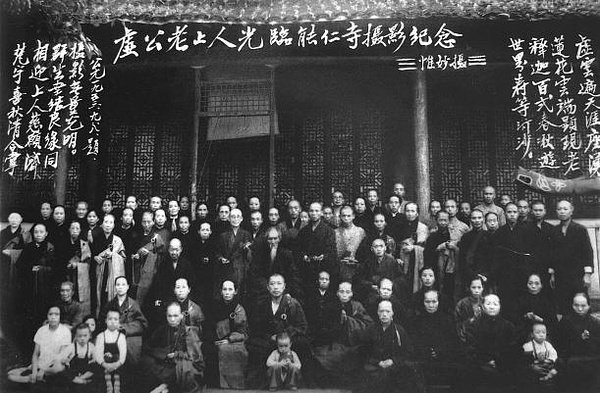
1952 上海 Shanghai
After the meeting was over the Master wished to leave Shanghai city but he was asked to hold a meditation retreat for one week at the Jade Buddha monastery which had a large meditation hall. The master agreed to this and the retreat began on February 22nd. Then, because of receiving more donations, they held another week straight after it had finished. (His lectures were all recorded during these two weeks, please read the meditation page.)
The Master then went on to Hangzhou, staying at Compassion monastery or Jinci Si. While there several thousands of the faithful became his students, formally taking refuge under his spiritual guidance. The local government asked him to become abbot of Ling Yin monastery but he said no because of his age and health. He was then asked to go to Suzhou to lead a Dharma meeting, and after that he paid a visit to Tiger Hill. There he paid his respects to the stupa of Master Shao, long a descendant of Master Lin Chi (who founded the Lin Chi Chan School). When he got there he saw that the site had been plundered. The last time he had been there was when Emperor Guang Xu was on the throne but now the site was demolished. The Master talked to the local government and they contacted Buddhists from Shanghai who gave enough money to rebuild it. The abbots Miao Zhen and Chu Guang were asked to stay there and supervise. On the way to Suxhou the Master stopped at Shou Sheng monastery in Ban Tang. There he paid his respects at Master Yuan Shanji’s stupa. Then the Nantong Buddhists asked him to go to Lang Mountain. There he held a Dharma meeting and several thousand people formally took refuge under the Master. He then returned to Shanghai in March. In April a telegram came from Beijing asking the Master to go back there. He went and stayed again at Guang ji monastery. There the Buddhist Association was formally founded and many monks came from all over China. Some monks attending wanted to change the precepts, they wanted to end vegetarianism and celibacy as in Japan & some even bought their wife’s along. The Master refused firmly, loudly thumping his fist on the table. His wishes were agreed to and accepted by the government. After he wrote an essay on the corruption of the Sangha in the Dharma- ending age.
Master’s 115th year 1954 – 1955
The Master then went to Da Tong in Shansi province. There, at the Yunguang caves he paid his respects. He then wished to leave the Beijing part of China. In May, the Master went south with his assistant, Jue Min. Arriving at Hankou, the abbot of Bao Tong monastery, Yuan Cheng, asked him lead a Chan meditation retreat for two weeks. Then he was advised to go to Lu Shan or Lu Mountain in Jiangxi in order to recover from his recent ordeal, where his lay student Chen Zhenru awaited his arrival. He stayed convalescing at the small corragated l tin roofed; Great Wood or Da Lin monastery, which is now submerged under a man made lake. Lu mountain is cool and refreshing and considered a therapeutic place, the Communist party used to hold their meetings & entertain foreign guests up there in a town near the summit called Gulin. A lot of the architecture is European, and there is now a museum where Chairman Mao had a Mansion.


