Epilogue
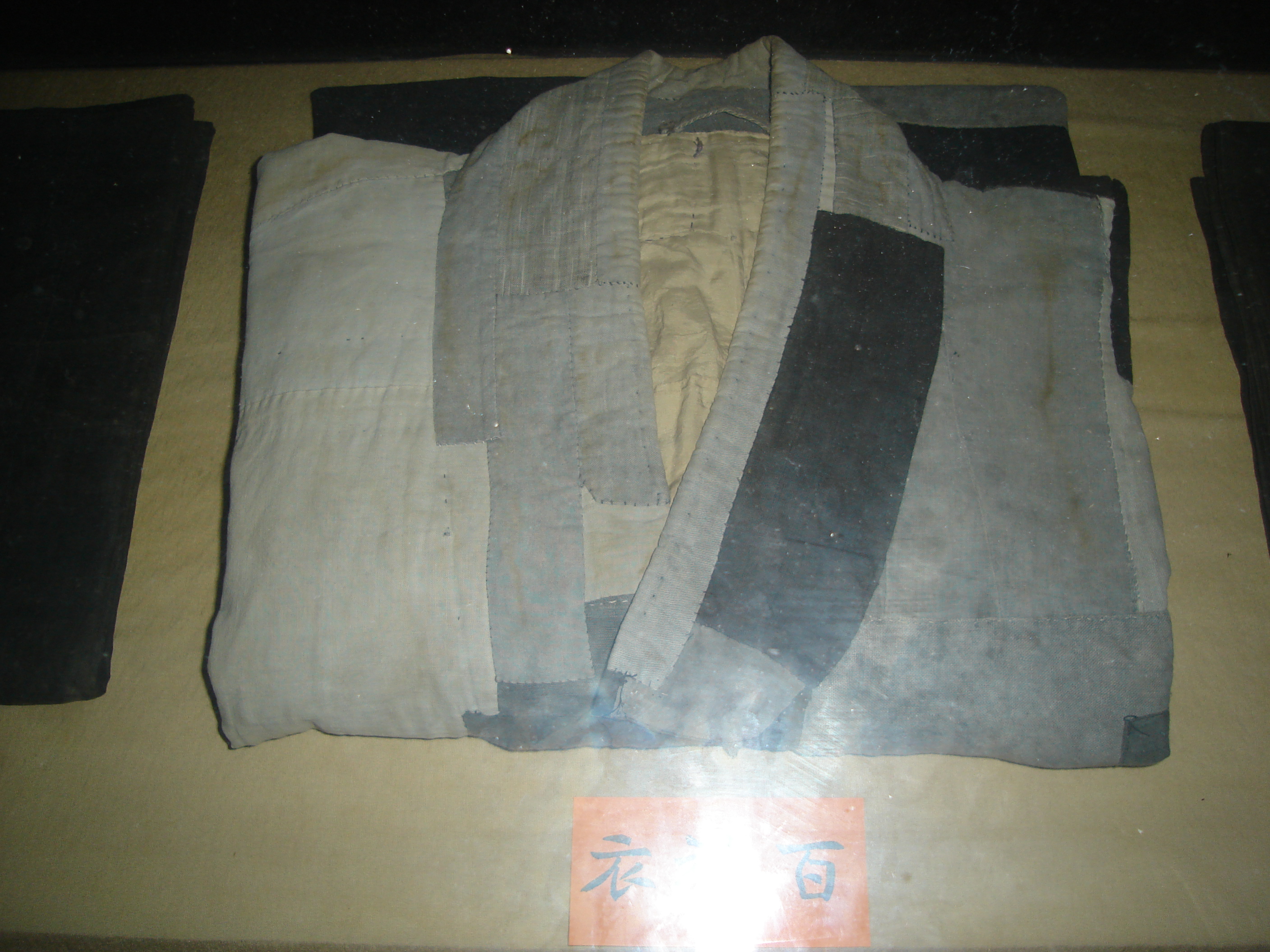
The Masters Old Patched Robe
Master Empty Cloud died on the 13th of October, 1959. His body was placed in a coffin on the 18th. The very next day there was a fire on the mountain not far away. There were around a hundred people still living at the monastery and everybody went to help to put it out, except for the sick and the elderly. The Master’s body was quietly cremated by only three monks on the 19th. After the pyre died down Masters Kuan Huai and Kuan Ke looked into the cremation furnace holding the Master’s remains and both were surprised to find his body still holding its shape despite having been thoroughly exposed to the flames. They both thought that this was a really unusual event. They touched the body with a piece of tile and only then did it crumble into ashes, falling to the bottom of the furnace. Master Kuan Huai reached inside the furnace and among the ashes found a number of bright crystal-like relics or Sarira. Not long after this, the people who had gone to fight the fire, returned. The knowledge soon spread that there were many relics or Sarira. Many people excitedly rushed in and tried to grab some of these, and some fled to hide them in the hills, as at that time the government did not allow the keeping of such things. The relics were all different colours, shapes and sizes, and there were many. Then the Abbot Master Xing Fu ordered Masters Hui Tong and Zi Xiu to guard what remained and to sieve out the remaining relics. Amongst the relics or Sarira that were found some glittered and were translucent like quartz & one was crystal clear and about the size of a thumb it is kept in the Monastery there today in the Abbots hall. Master Da Ding or Great Certainty was working in the vegetable garden during the cremation and when he arrived he was too late for the cremation, he found only a piece of bone left, which he took with him back to the vegetable garden. He broke the bone into pieces and found a blood-red diamond-like relic, a similar size to a red-bean, and another smaller relic stuck to a piece of the bone. Another Chan monk returned to the temple after he had been fighting the fire. When he heard that there were relics among the ashes he ran to the cremation furnace. However, when he arrived he found only an empty furnace – even the ashes had been swept clean. Seeing this he burst into tears and started digging in the ground with a piece of bamboo. After digging around for a while suddenly, a couple of inches down, he discovered a crystal clear, bright white relic or Sarira about the size of a soybean! He was so happy. Some of these relics have now been placed inside the Empty Cloud Stupa just outside the front of the monastery. Underneath it is a vault used for storing the ashes and relics of the deceased monks who had trained there. There were those who wished to make the old monk’s students look like frauds and they said that the relics were made out of amber, and that these bits of amber had been dropped into the cremation furnace. However, this was disproven when a test was done, as amber placed into a hot fire turns to ash.(There is evidence that under certain conditions of heating, human bones can form crystalline structures. In one chemical analysis Sariras were found to be composed of the constituent elements of both bones and stones. Wikipedia) The news of Master Empty Cloud’s passing was kept secret because of the worry of what might happen next. At this time life in China was so difficult and so very confused. The monastery kept running for a few years until it was used as a school to teach Chairman Mao’s poetry and politics. The main hall was filled with his poems which were pasted to the walls.
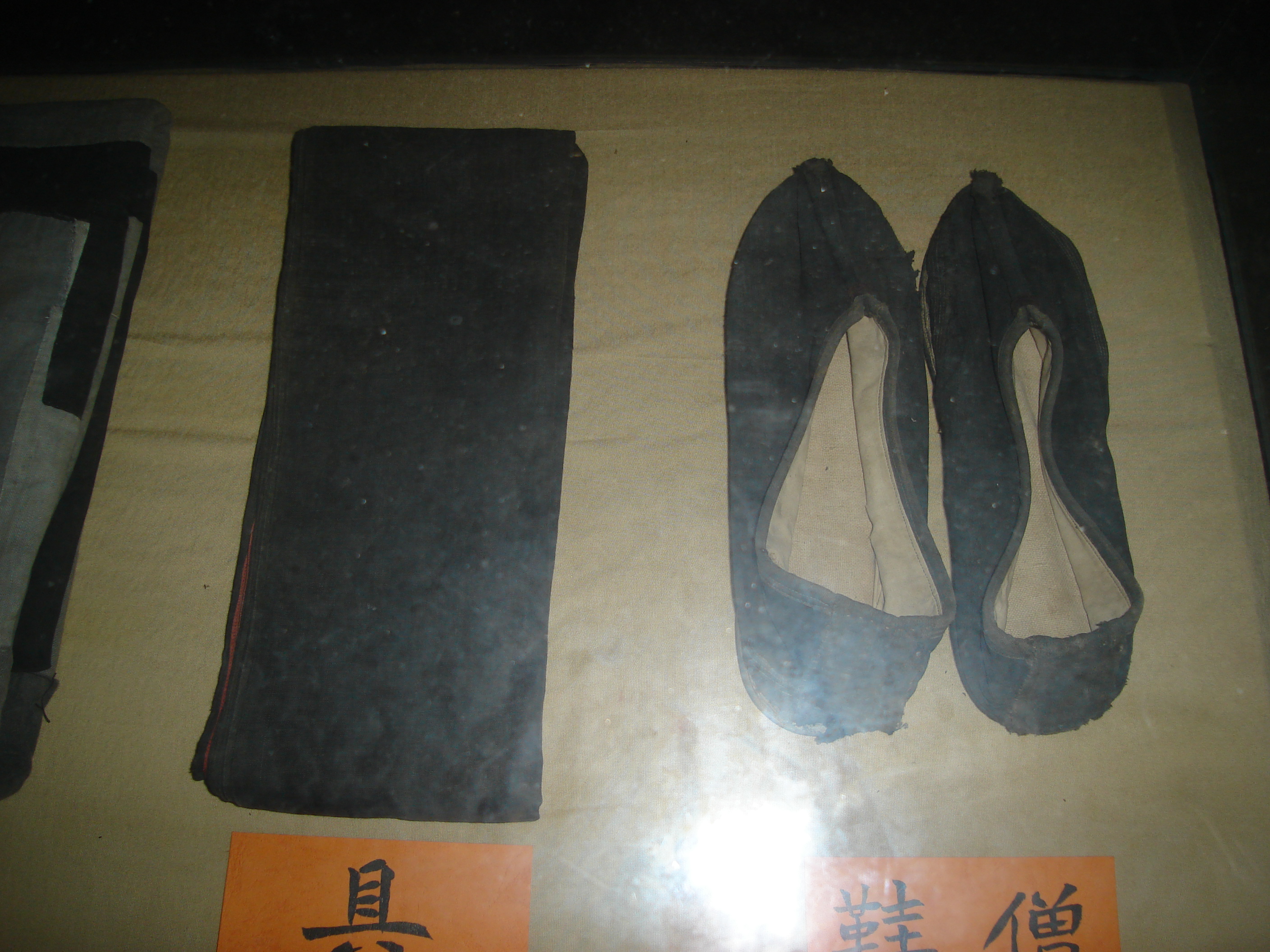
Masters bowing mat & shoes.
Then in 1967 the few remaining monks were taken down the mountain and made to work for the forestry department. Then, in 1978, Master Yi Cheng, who was a skilled stone mason and who had maintained his strong practice through all this difficult period, became the next Abbot of the True Suchness or Zhen Ru Chan Monastery. He led a group of monks back up the mountain to reopen it in 1978 & it soon became the cultural treasure that it is today. Now it is again holding regular and long meditation retreats. It attracts many new students from all over China and also puts on large public workshops for teaching Buddhism. Visitors flock daily to the very special atmospheric stone memorial hall, just behind this monastery. It is located exactly on the site of Master Empty Cloud’s former cow shed and was specially built to house his photo collection, books, old robes and other special items. My teacher, Master Sheng Yi or the Saintly One and Master Shao Yun or Continuous Cloud, were some of the last to ordain under Master Empty Cloud. Also, so were Master Husan Hua, who went to America and founded the city of Ten Thousand Buddhas, and Master Ming Hai who later became the Abbot of the massive Cyprus Grove Monastery in North China. Master Ben Huan became Abbot of a huge new monastery in South China. Master Fo Yuan remained Abbot of Cloud Gate Monastery. Master Dy Jin went to Honolulu to found a monastery there. They and others all went on to become great teachers representing the grand old Master himself. They have almost all now passed away except for his personal assistant Grand Master Shou Yun (who is still active), and so the next generation of monks continue the work. A large international meditation monastery is currently being built right now just outside True Suchness monastery.
Master Xu Yun or Empty Cloud inherited all five Chan schools and breathed a new life into the old lineages; he carried them into the present time. He almost single-handedly revived and preserved the Chan doctrine in its many forms in China.
In the Yun-Men lineage, he was the 12th generation Dharma heir.
In the Lin Ji lineage, he was the 43rd generation Dharma heir.
In the Cao-Dong lineage, he was the 47th generation Dharma heir.
In the Wei-Yang lineage, he was the 8th generation Dharma heir.
In the Fa-Yen lineage he, was the 8th generation Dharma heir.
Master Empty Cloud had asked for his ashes to be mixed with flour, water and sugar and made into seven balls, to be then fed to the fish in a large lake called Xi Hai at the bottom of the mountain; his monks did this for him.
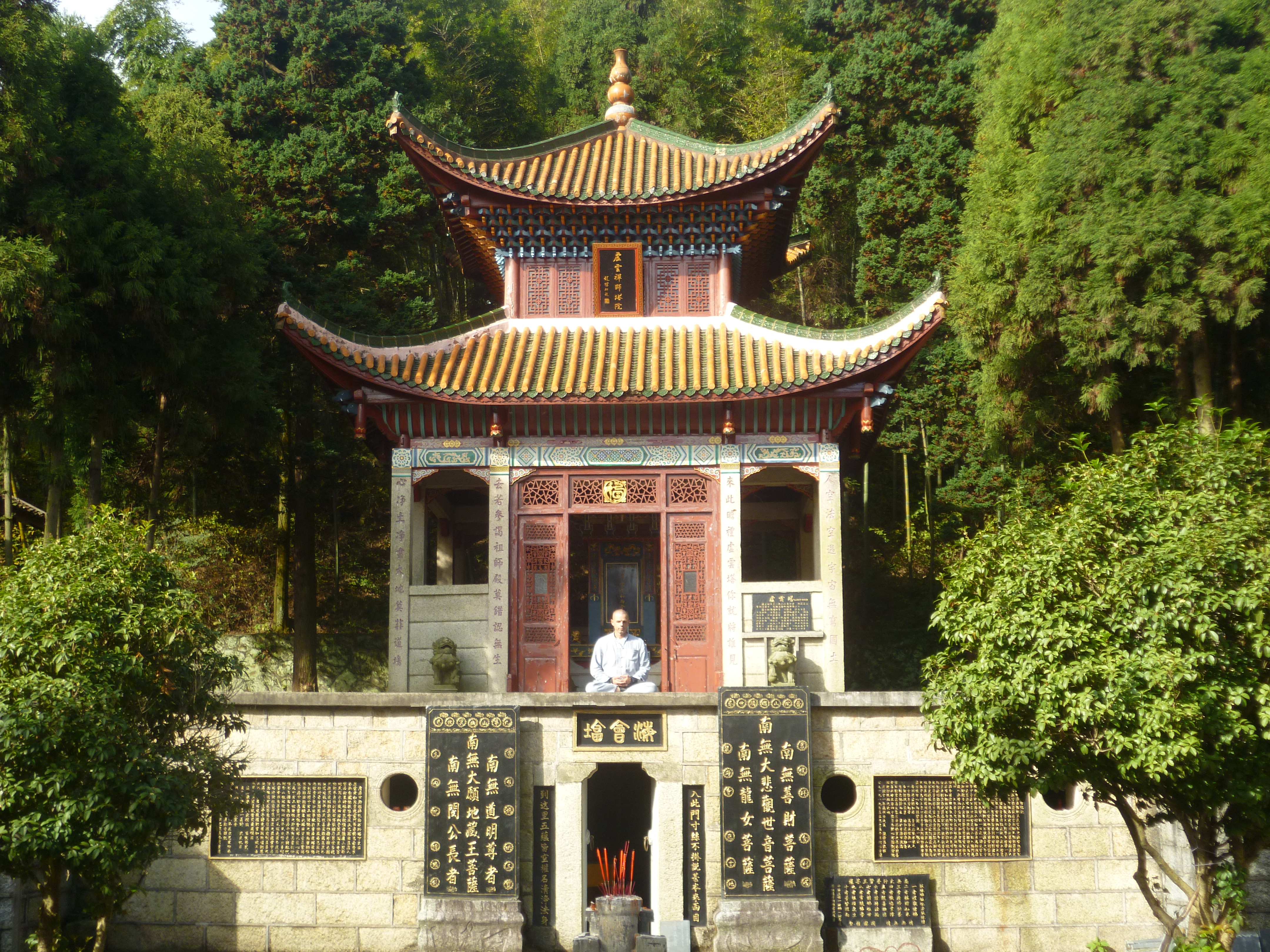
Master Empty Clouds Relic Pagoda. Just outside True Suchness Monastery’s main gate. Cloud Abode Mountain. Near Nanchang. 2011.


