Abbot at Cloud Gate Chan Monastery
My Hundred and Fifth Year 1944 – 1945
The monastery of the sixth patriarch was now completely restored. One day I went to find the site of the ancient Ling Shu monastery together with masters Fu Guo and Qui Jiang. However, we could not find it so we went to Cloud Gate Mountain and discovered an old run down temple in thick woodland. Inside was the mummified body of Master Cloud Gate, or Yen Men, the founder of the Cloud Gate Chan school (one of the five schools). When I saw the state of this place it made me so sad I cried. There was only one lone monk living there named Bright Emptiness or Ming Kong. He had been there since 1938, living in tough conditions, staying on to revere the sect’s founder’s mummy. Telling us his story he said that if the monastery was not quickly renovated it would slip away into history. One day, after returning to South Flower monastery, I told this story to Field Marshal Li Jishen and Chairman Li Hanyun. Soon afterwards, whilst Chairman Li was patrolling on duty he travelled through Ru Yuan near Cloud Gate Monastery so he went to have a look at it. It was just like South Flower monastery before its restoration. He arranged a meeting between some monks and other important people, and I was invited to take over the renovation of Cloud Gate monastery. When I got to Cloud Gate I could see that only the hall of the Master Cloud Gate still stood, and it was about to collapse, and most of the other buildings were already in ruins. Moving into a small room behind the shrine to Kwan Yin, I planned the renovation of this holy place. That winter, I went back to South Flower monastery and led a ceremony of remembrance. We thought the war would reach South Flower monastery, so one day we took the mummified bodies of both the sixth patriarch and Master Han Shan in secret to Cloud Gate monastery for safety.
My Hundred and Sixth Year 1945 – 1946
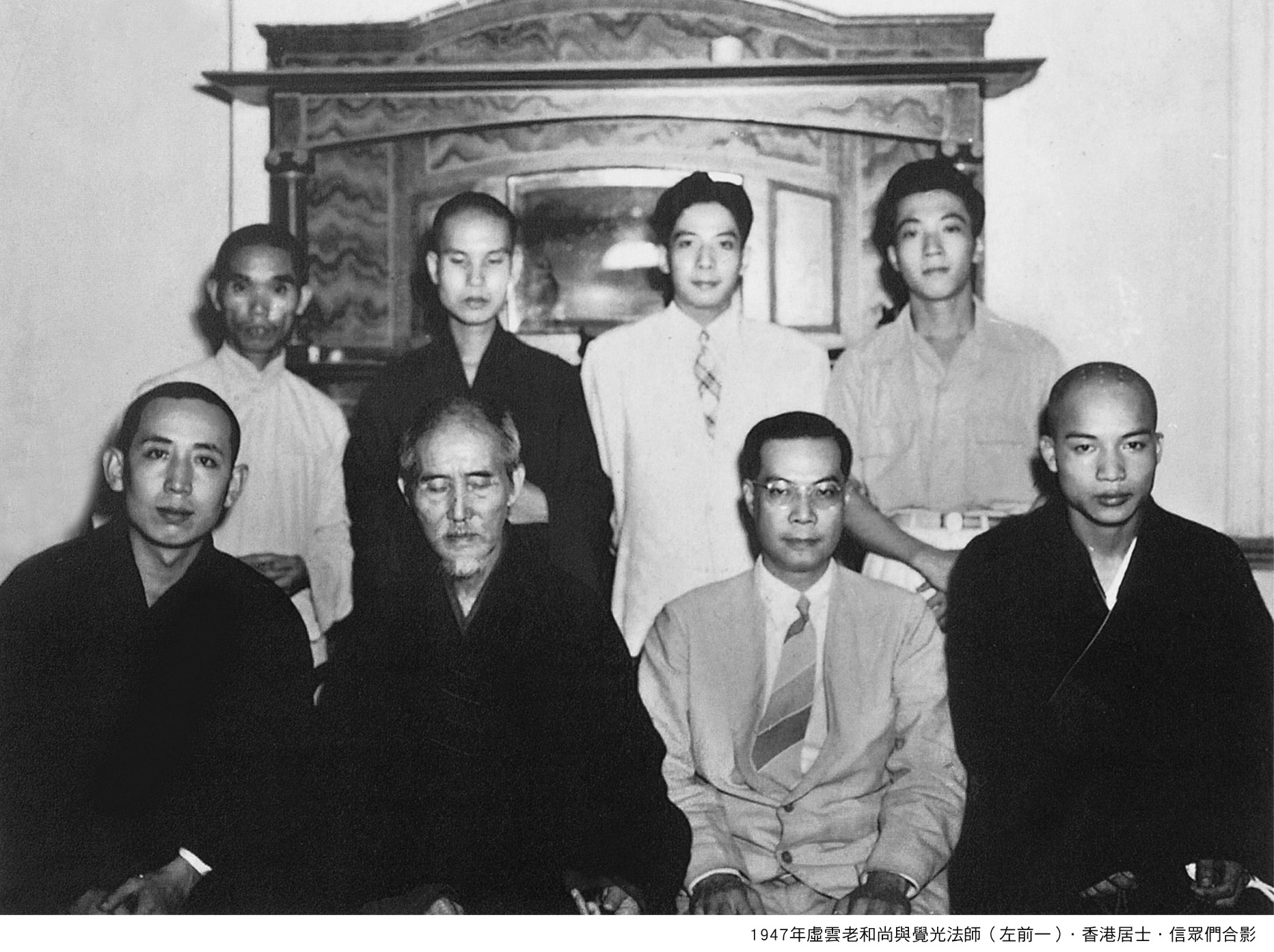
1947 Hong Kong
The Japanese army attacked the north of Guangdong and many areas became occupied, including Ru Yuan. Many refugees, in their desperation, came to Cloud Gate monastery. We all shared our food with them – first rice, then gruel and then potato flour, when all else had gone. Amongst them were about one hundred skilled builders and they offered to work for free. This really helped the rebuilding of the monastery. During the summer, the Chinese army changed its position and some local bandits wrongly guessed that they were retreating and attacked them. They took most of the army’s food, but soon reinforcements came and the army then went to attack around forty villages where they thought the bandits were hiding. About one thousand village men and women, young and old, fled to the mountains with their livestock and clothes. The village elders came to Cloud Gate monastery to ask for my help. I talked to the commander of the army and, three days later, all that had been plundered was returned and the army was content. Both sides signed an agreement and things settled down to normality. After that, the villagers looked to me as their compassionate father. The Japanese were in occupation, but they never visited Cloud Gate Monastery and they kept away from the angry locals. (Master Empty Cloud was in fact both respected & feared by the Japanese, after they had failed to Bomb South Flower Monastery. So much so infact, that they gave him & his disciples free passage in the area)
My Hundred and Seventh Year 1946 – 1947
The Second World War finished and the government offices returned to their original places. That spring I transmitted the precepts and read sutras as usual. That autumn all monasteries were ordered by the central government to hold remembrance ceremonies for the war dead. Then, in November, as a response to an invitation, I also held a similar ceremony at the Six Banyans monastery. During the ceremony some peach trees there suddenly came into flower. There were over 100,000 people there who witnessed this out-of-season flowering of the trees. Upasika Zeng Bishan embroidered the scene with the Buddha and peach blossom, and Upasika Hu Yisheng painted a picture of the peach flowers to commemorate the auspicious event. Official and important people from Chaizhou and Shantou then invited me to lecture on the Buddha’s teachings at Chauzhou’s Kai Yuan monastery. There, many people came to receive the Buddhist precepts. Then, my top student, Contemplating Root, passed away that November.
My Hundred and Eighth Year 1947 – 1948
That spring I transmitted the precepts and lectured on the Sutras at South Flower monastery. Then I was invited again by the Donghua hospital group in Hong Kong and I was asked to conduct a prayer meeting there to benefit the Crown Colony. I stayed at the Chong Lan School where Upasika Zeng Buishan gave me all the help I needed. A few thousand people there became my students. Some of my students invited me to Macow to hold a one week meditation retreat and give some sutra lectures. Then I was invited by Upasika Ma Shichuan to Zhong mountain where I conducted the Great Compassion ceremony and a few more thousand Buddhists became my students. I then went back to Cloud Gate monastery to speed up the renovation.
My Hundred and Ninth Year 1948 – 1949
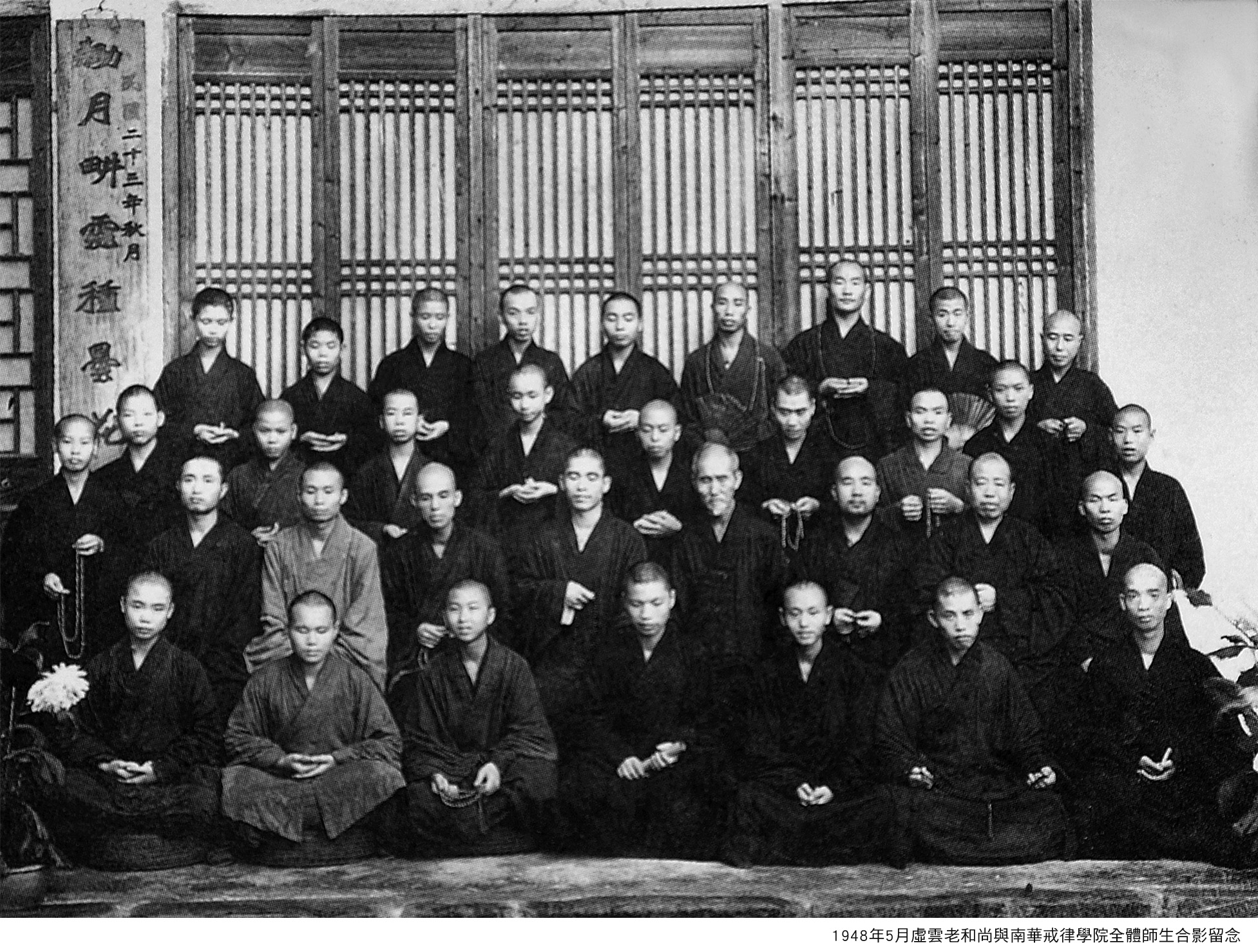
1948 South Flower Chan Monastery
That spring, I transmitted the precepts at Cloud Gate. Then I went to Canton for the opening of the Zhi De Buddhist hospital where I gave some talks on the Dharma. Then I went to Zhi Lin temple where I lectured on the five precepts and also talked about taking refuge in the triple gem. Next, I went to Shatin in Hong Kong to give sutra lectures at the Ci Hang Jin Yuan temple. Then, at Zhi Lin temple I led a week of meditation of the Pure Land school, also leading a ceremony of reform and repentance at the East Lotus Enlightenment Garden. Then I went back to Cloud Gate monastery. Master Jia Chen died that May in Yunnan. Then, in the autumn we had an American visitor who came and received the precepts. We also held a week’s Chan meditation at that time. Filled with joy, she stayed on for two weeks before returning home to America. (Cen Xuelu says here, ‘That year, the Master heard through the American Embassy and Chinese authorities that an American woman named Amanda Jennings had heard about him and wanted to come and visit him in China. He replied that he would be most delighted to receive her. She went to Hong Kong first and then travelled on to Canton to meet him. Her father held a doctorate in religion and she had studied comparative religions for twenty years. She told the Master she had come for the Dharma. In India she had lived first in seclusion and then on retreat for four years in the west. She had worked at the League of Nations for three years, helping to establish world peace. Eventually, she concluded that peace can only be found deeply on a more personal level and so she had turned to Buddhism, there, looking at the highest levels which alone can release the mind from its Samsaric approach to war and the end of war, and realising that, ‘when wrong views slip away the mind is at peace’. She went with the Master to South Flower monastery where she bowed before the sixth patriarch’s mummy. Then she took the three refuges and was given the Dharma name ‘Investigating Emptiness’ or ‘Kuan Hong’. A week’s Chan meditation was held and people came from far and wide to attend it in great numbers. At the beginning of the retreat, the Master entered the hall and said, “Talking about this ‘thing’, it is inherently perfect. It does not increase in a holy state or decrease in a worldly one. When the ‘thus come one’ transmigrates through the six realms of existence each realm hears of it. When Kwan Yin passes through the ten species of living beings, each one is in the ‘such’ state. Why do you seek and search if all is ‘thus’? The Master continued; An ancestor once said, ‘When the differences arise you are already lost in the following confusion. Even before your boat was moored, I should have dealt you thirty blows with my staff. What a shame! You have come to this thatched hut to get straw worth nothing. Why didn’t you open your own treasure house? All of this started from one single deluded thought. A mad mind that cannot stop is like another looking for his own head whilst he holds it in front of himself. Or it is just like having water in front of you and still asking for some. Dear friends, why did you take the trouble to make the journey here? Why? Since you don’t mind buying straw sandals, I won’t hold back my shout’. The Master then shouted out, ‘Tsan, (investigate) the grand old man from Shakyamuni has arrived”. During this retreat several other elder Chan masters also gave lectures and instructions. Amanda Jennings also had a Dharma conversation with the mendicant monk, Master Chi Shi, one of Master Empty Cloud’s students. He asked her, ‘You have risked danger in crossing the ocean in order to come here. Why have you done this?’ Amanda answered, “I wish to penetrate the Buddha Dharma”. He asked, ‘How do you understand birth and death? You need to be clear about this’. She replied, ‘Since birth and death are illusionary, why have ideas about them?” He asked, “Then why study the Buddha Dharma if there is no birth or death?’ Amanda replied, “What use is there in studying the Dharma if there is no birth and death?’ He replied, ‘He who realises that fundamentally there is no Buddha knows that fundamentally there is no birth and death.’ He then said, “The Buddha had the twenty-three special marks. He could make the ocean sign glow. Can you?’ Amanda said, ‘If you can or cannot do likewise, it is only opinion about things’. He answered, ‘What you say is right and your understanding is deep, but words cannot stop hunger. What do you regard as the ultimate statement?” Amanda replied, “There is no ultimate statement and no words can reach it. There are no ideas or views to be found in the non-thinking nature of enlightenment’. He said, ‘Your words match the meaning of the patriarchs in all the details. Knowledge leads to all sorts of problems. But you have entered in the correct way. Now tell me without using words, what is your original face?’ Amanda said, “The Diamond sutra teaches that complete enlightenment is not complete enlightenment’. He replied, ‘It seems so. However, you cannot cut off the root of life by knowledge and opinions. Please investigate’. Amanda said, ‘I did not have much time for sutra study. After my long retreat, others said I was in harmony with the Dharma. I feel that understanding from outside of the scriptures is not a part of the human mind”. He said, ‘That which comes from outside of the study of Sutras and commentaries but appears in meditation, is it only human or is it cosmic mind?’ Amanda replied, ‘Buddha wanted true realisation which did not rely on the human mind’. He said, ‘By avoiding dependence on words in sutras or commentaries and by not getting stuck in self nature, the ‘Thusness’ is to be found everywhere with the truth, at any place where you are’. Amanda Jennings was then taken to Cloud Gate monastery by the Master, where she stayed for two weeks. She told us that when she got back home to America she would teach Buddhism’
My Hundred and Tenth Year 1949 -1950
That spring I transmitted the precepts at South Flower Monastery and then I went back to Cloud Gate monastery. There I took charge of the making of more than eighty statues together with their stands and
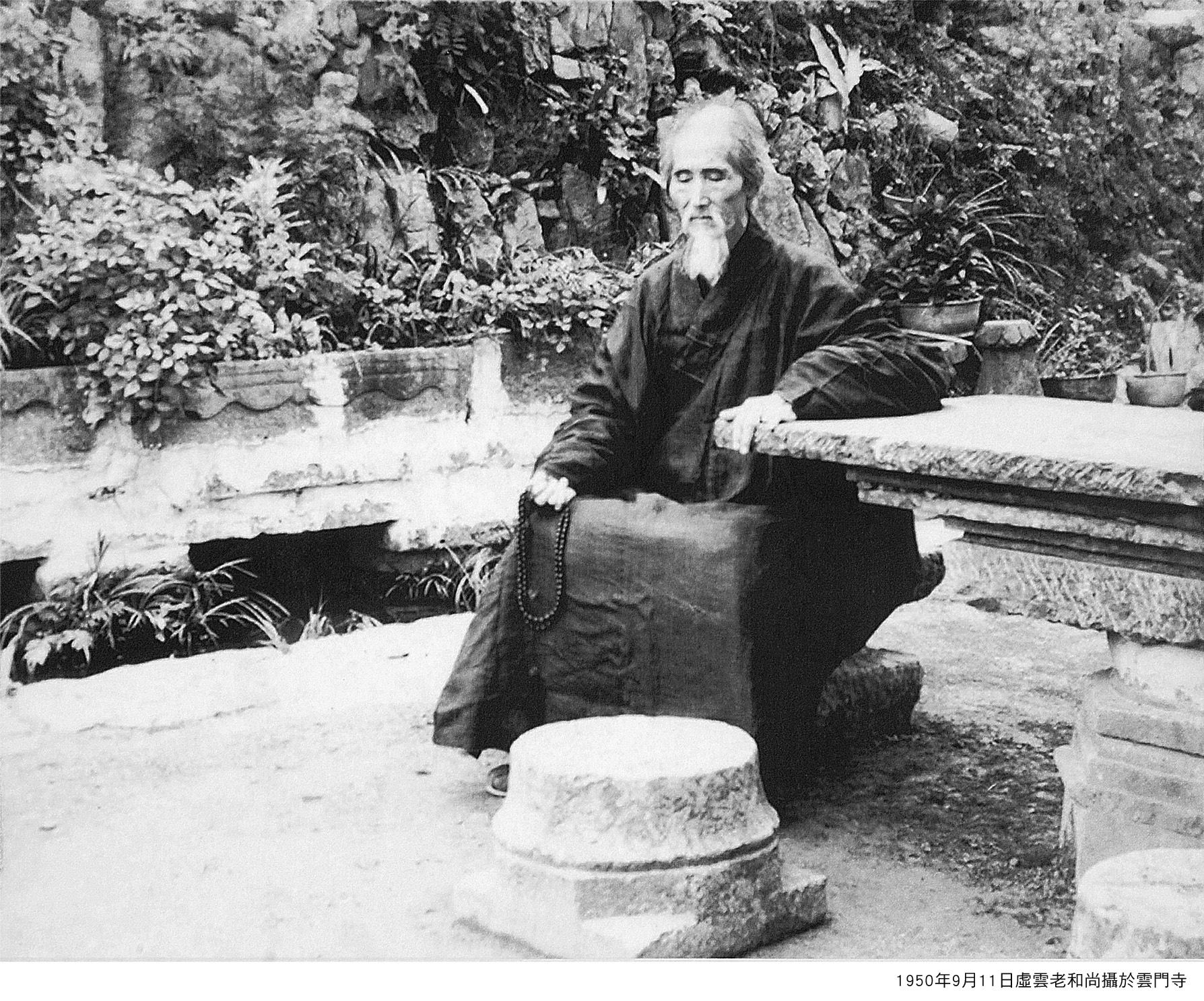
1950 Cloud Gate Chan Monastery
gold leaf. That took us more than one whole year to accomplish. Ninety per cent of the renovation had already been completed. I was then invited by Upasika Fang Yangqui to inaugurate his new Buddha shrine in Hong Kong and whilst there I lectured on the sutras at the Wisdom School. I spent a month in Hong Kong before returning to Cloud Gate monastery. This was the year that I asked Cen Xuelu to edit the history of Cloud Gate monastery. (Cen Xuelu says here, ‘When the Master came I asked him, “The world is changing so fast, where is it best for me to go?’ He replied, ‘For a student of the Way, everywhere is his home. If you only put everything down you will be at home anywhere. Please, just let your mind be at rest’. I then said to him, “What is happening on the mainland will have an effect on the monasteries there. Why don’t you please stay here with us and teach the Dharma?’ The Master said, ‘I have a special responsibility back on the mainland. Others here can teach the Dharma. My mind is beyond coming or going, but I must return because things will get worse there and I must help the tens of thousands of monks and nuns. I cannot stay here and be content.)
My Hundred and Eleventh Year 1950 – 1951
That spring I transmitted the precepts at South Flower monastery. Afterwards, we held a meditation retreat for seven days. A few of those present experienced an awakening. Then I went back to Cloud Gate monastery and, whilst there, I collected all my documents and writings together so that they could be edited. Most of them had been written decades before, so this was no easy task.
My Hundred and Twelfth Year 1951 – 1952
That spring, as I transmitted the precepts at Cloud Gate monastery, suddenly great misfortune came my way.


