Moving to Cloud Abode Mountain
Masters 116th year. 1954-1955
That June, the master had a visit from a few Chan monks. They had come from Zhen Ru Chan Si or True Suchness Monastery near Nanchang in Jiangzxi Province, not far from Lu Mountain. They told the Master how the Japanese had set fire to the monastery and then destroyed it to stop the Chinese resistance using it as a hide-out. The monastery had been completely destroyed except for the statue of Vairocana Buddha & a large bronze bell that had a large crack in it. The site was grassing over and was now just a ruin. It had been built in the Tang dynasty, over one thousand years earlier, and was now in danger of becoming lost forever. The Master was sad hearing this and so he made a vow to rebuild it. He applied to the Government for planning permission to go there and restore it, and this was soon granted. So, on September 9th the master walked unaided up the mountain, refusing a sedan chair, declaring that he had muscles and would use them. He climbed up with the Buddhist Zhu Huabing and few other faithful practitioners. There were also four policemen armed with pistols to protect them on the ten mile climb up. They arrived at the ruins later that day and found only four monks there living in an old cow shed just behind the site, they were busy cooking and cleaning up. The Master liked the quiet remote cowshed and moved in making it his last home.
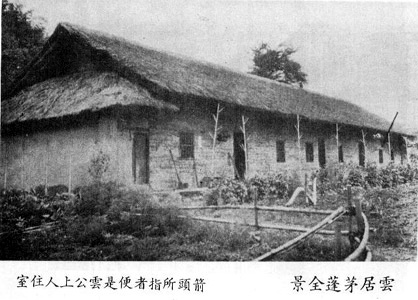
The converted Cowshed 真如禅寺 云居山
Then later on that month, a few nuns turned up. They had come from Hong Kong by train & boat. On arrival at the ruins they met a monk and asked him where the old Master was and he pointed out the converted cowshed to them. They went over and stooped under the low doorway to get inside. At first they could not see him, but as their eyes got used to the darkness in there, they saw the Master sitting quietly in meditation. Slowly he opened his eyes and asked them why they had come. He told them how there had been only four monks living in the cowshed but now over fifty had arrived within a month, so they would just have to manage with what was there. Then, in September even more monks arrived. There was almost no food and it was all old and moldy. Empty Cloud made his plans on how to rebuild the monastery and cultivate the flat land to grow vegetables & the tea bushes he personally planted still grow there today. That winter the Master went back south to the South Flower Monastery to transmit the precepts & then returned to his Cowshead
Masters 116th year. 1955- 1956
That spring, the Master made plans to rebuild the main hall. They made used clay for mortar it still stands proud & straight today. Toilets, a brick kiln and rice-pounding rooms were all completed. Previously, the hall had been tiled with heavy cast iron tiles because the clay ones blew off during the strong winds up there. The Master ordered new iron tiles and four big woks for cooking, and also two big bronze bells. By then, there were many monks and laymen in residence. They included a lot of skilled workmen who were happy to work for no pay. Money started to flow in, mainly from Shanghai and also from Hong Kong and Canada, so the reconstruction was an easy thing to accomplish. The community was divided, half for the reconstruction and the rest to clear the land to start the Shangha farm. Everybody was happy to help so by the end of June the Dharma hall was also completed with a library upstairs. Ten acres of land had also already been made ready for rice cultivation. By July, more than twenty dormitories were finished. The Master continued to live in the converted cowshed.
Masters 117th year. 1956-1957
Master Sheng Yi recounts;
‘One day, Master Empty Cloud asked me to wash his clothes for him. I found that the most wonderful smell like incense came out of his clothes while I washed them. I asked Empty Cloud how to cultivate Chan. I was told to go and eat peanuts with the others. At first I thought Master Empty Cloud did not understand because of our different dialects. However after contemplating this for a few months I eventually realized that just to eat without a discriminating mind was Chan. When Empty Cloud walked there was no noise at all & he could see in the dark easily’.
Master Empty Cloud held him in high esteem. He transmitted the Wei Lang lineage to him together with the purple Kesa that had been given to him by the emperor of China, telling him to go back to Hong Kong until conditions were once again good enough to return there.(See the about us page)
………………………
In the 90’s Master Shao Yun gave a series of lectures at Master Sheng yi’s monastery in Hong Kong & said this;
“During 1956, when Master Empty Cloud was 117, I became his personal attendant. I had been writing to him from Nanchang and decided to go and meet him. He asked me why I had come. I told him I wanted to become like him or a Buddha. He was very happy to hear this. “The Master was almost two meters tall. He had long arms and his eyes were blue, piercing and bright. He never needed glasses and could even read the small Chinese characters in a newspaper at night with only a small lamp. He had a good set of teeth, saying that when he was ninety he grew his third set. His voice was so strong that when he spoke in the Chan hall you could sometimes hear the bell ring in response. ‘When I got there most of the agricultural land had already been cleared. The Master was organizing all the rebuilding work and the vegetable farm by himself. Every single day he had visitors and many famous people also came.
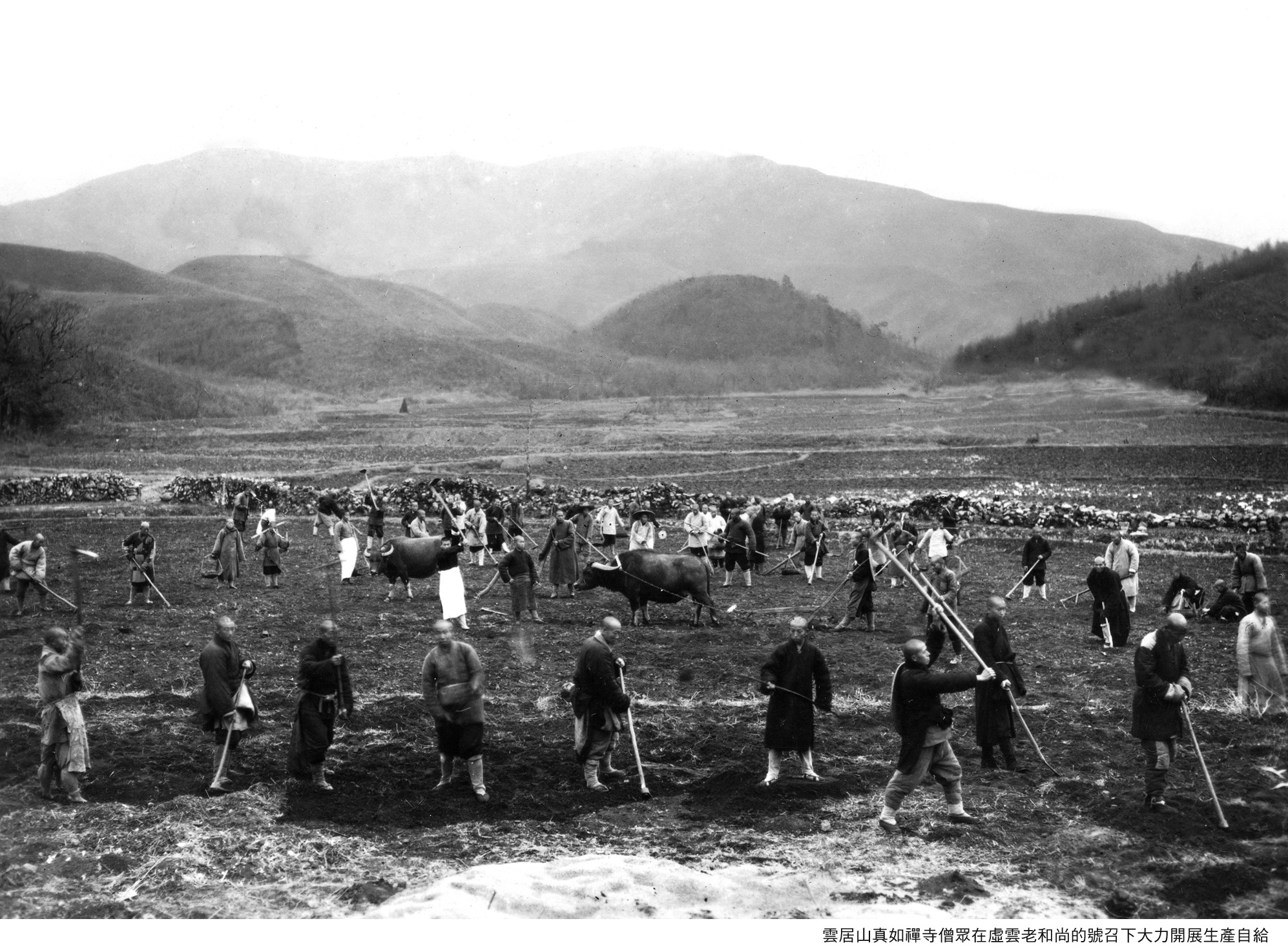
真如禅寺 云居山 Cloud Abode Mountain. The farm.
In the evening he went to teach & sit in the meditation hall at 6pm for two hours. Then, at 8pm he went back to the cowshed to read the letters that had arrived for him that day. Often there were more than one hundred of them. The most important ones he personally replied to. As for the others, he would dictate a reply for others to write for him. The Master would lie down to sleep at midnight until 2am when he got up to meditate for one and a half hours.
“The Master did not have a toothbrush – in the early morning he just rinsed his mouth with warm water which he then spat out into a bowl of warm water. He mixed this up carefully, then slowly washed his face with it. He said it was good for his eyes. Then he went to do prostrations in front of the Buddha statue in the main hall, afterwards returning to his room in the cowshed and meditating again until breakfast at 6am.
“Life was tough despite the vegetable farm. There was rice and some millet and we had a lot of sweet potatoes – we also ate their skins and stems. We mixed the potatoes with rice into congee (porridge) for breakfast and we ate vegetables for lunch and the leftovers for supper. There was not enough food and some monks skipped meals so that the others could eat more. The Master always ate the same as the rest of us. His lifestyle was very frugal and simple.
“Cloud Abode Mountain is over 1.100 metres high and so everything freezes in the bitterly cold winter – the sweet potatoes were stored underground but even then they froze and became black and bitter. One day, as I was eating with a guest near the Master, we took the bitter black potato skins out of the congee and put them on the table as inedible. After the meal was over the Master came over and quietly ate the skins. He embarrassed us so much, we never again wasted any food. He said, ‘This is food. You must eat it and set a good example to others. Just be thankful for what you can get.’ “Another day, Mr Zhang, who was the local government minister for religion in Jiangxi province, came to meet the Master. The Master himself cooked for him and then invited him to eat. Mr Zhang was a proud man who was used to being waited on and he had little sympathy for other people. While he was eating, a few grains of rice fell on the floor. The Master saw this but said nothing. After the meal the Master went down on his knees and picked up the rice dropped on the floor and ate it all. Mr Zhang blushed red and he looked ill at ease. He said, ‘Master, this rice is dirty off the floor. How can you eat it?’ The Master replied, ‘Do not worry about it, this food is OK to eat’. Mr Zhang said, ‘Old Master, please try to make your life a little better’. The Master said, ‘Well my life is like this and it is good’.
“Master Empty Cloud’s teeth were particularly good. Once, a lay-Buddhist scholar sent some fried soya beans up the mountain as a gift. The old Monk saw that we were eating and so he also began to eat. We said, ‘These beans are very hard on your teeth. Will you be able to eat without damaging them?’ He said nothing, but just picked up the dried beans and started to eat them and he ate faster than us. We were surprised.

1959 真如禅寺 云居山 True Suchness Monastery.
“Early every morning, besides eating two bowls of congee, sometimes he also ate a potato. At noon, he ate two large bowls of rice. In the evening, sometimes he would eat a small bowl of noodles or a bowl of congee. The Master said that he had only started to take a little food in the evening as a ‘medicine’, as well as acupuncture treatment because of the Cloud Gate incident. Before that time he never ate after noon or before, also he lay down to sleep at night.
“Xu Yun could make do with whatever he had. For example, his straw sleeping mat was worn out and sometimes he would ask us to help him to repair it. Sometimes, it tore in the same place and it would be hard to repair again. I told him that maybe he could have a new mat as they were very cheap. After listening to my suggestion the Master told us strongly, ‘The energy that creates good Karma is not made from a new straw mat’. We were all speechless. Both in summer and winter the Master wore an old black patchwork robe. This robe had been repaired so many times, from many bits of old cloth. In the cold winter, the Master would also wear a cotton-padded jacket under this robe. “Empty Cloud told us that he used to shave his head and wash his feet only once a year, on New Year’s Eve. This is why photographs of him just before that time record his long hair and beard. But after the Cloud Gate incident Master Empty Cloud started to shave his head and wash his feet every two months or some times every month. His eyebrows used to grow surprisingly long, as long as six or seven inches, right down to his jaw. Sometimes these would get in the way while he ate, so then he would pull them out, but before long they grew back again. We used to collect his cut hair and beard and store them away safely, but these things were all confiscated during the Cultural Revolution.
In 1956 many more monks came to receive full ordination from the Master, so he applied to the central government in Beijing for permission to do this. Many other monks then heard and also came for full ordination under him. They came from all over China. There were also many trouble makers and so the police came to provide security in the monastery. Whilst living In Yunnan, on Chicken Foot Mountain, Master Empty Cloud would often meditate for seven or eight days and nights continuously. Sometimes people would arrive and bring the Master out of his deep absorption with the use of the Qin, a musical instrument made of stone which has a subtle, penetrating sound. Whilst he was living on Cloud Abode Mountain, we asked him whether this was true. He answered yes and we asked him why it was that on Yunju or Cloud Abode Mountain the Master did not appear to spend days deeply absorbed in meditation. Master Xu Yun answered that on Cloud Abode there was so much building and farming work to be done and his time was taken up with the organisation of the work, as well as having to teach all those who had come to him for instruction. He continued with a smile, ‘If I meditated for days on end, some malicious person might think that I had passed away and burn my body by mistake. I don’t dare to meditate for a long time until the monastery is restored’. Although Master Empty Cloud did not meditate for seven or eight days at a time, he was very busy throughout the day and would often meditate through the night without any sleep whatsoever. So in this way he quietly kept his meditation practice strong. Master Shao Yun asked Empty Cloud, ‘Is it true that a sage has realised the Way?’ The Master answered, ‘Yes’. Shao Yun questioned further, “Is this the first attainment of the Arahant?” Empty Cloud said, ‘This is only the first attainment, the realisation of which is quite simple. It is entered by not allowing delusion to arise in the mind whether one is walking, standing, sitting or lying down. There is no more worry or anxiety and the six senses remain undisturbed in the midst of phenomena. In this way the practitioner enters the holy stream and becomes a sage. ‘It is said that when an Arahant appears to walk across the ground, his feet do not actually touch it.
Some people asked Shao Yun, as he often walked together with the old Master, did his feet touch the ground or not when he walked? On Cloud Abode Mountain it is muddy as it often rains. When most people walk around there, they find that their shoes soon become covered in mud, but Empty Cloud’s shoes always appeared clean. When we walked behind him, we could see his shoes touching the ground but when we got back and looked at them, there was no mud at all on them. This was a mystery.
During the second half of 1957, I saw Master Empty Cloud walking along one day, carrying two very large bundles of firewood towards the kitchen and I asked him, ‘Venerable Master, you are old, why are you carrying such a heavy load?’ The master put the firewood down and went back to his room. I went on into the kitchen to find who was responsible for the firewood. I saw the monk in charge of cooking and told him what I had just seen. He was surprised and said, ‘I just chopped three large bundles of firewood to use in the kitchen, but as they were so heavy I could only carry one at a time. I left the other two behind to get later on. I had struggled to carry just this one bundle. How did the venerable old Master manage to pick up the other two bundles and carry them? It is amazing’. I helped the chef-monk carry one bundle to the kitchen and it weighed about 200 pounds. The Venerable Master’s strength was incredible. (Firewood is still taken to the kitchen for cooking in this same way today.)
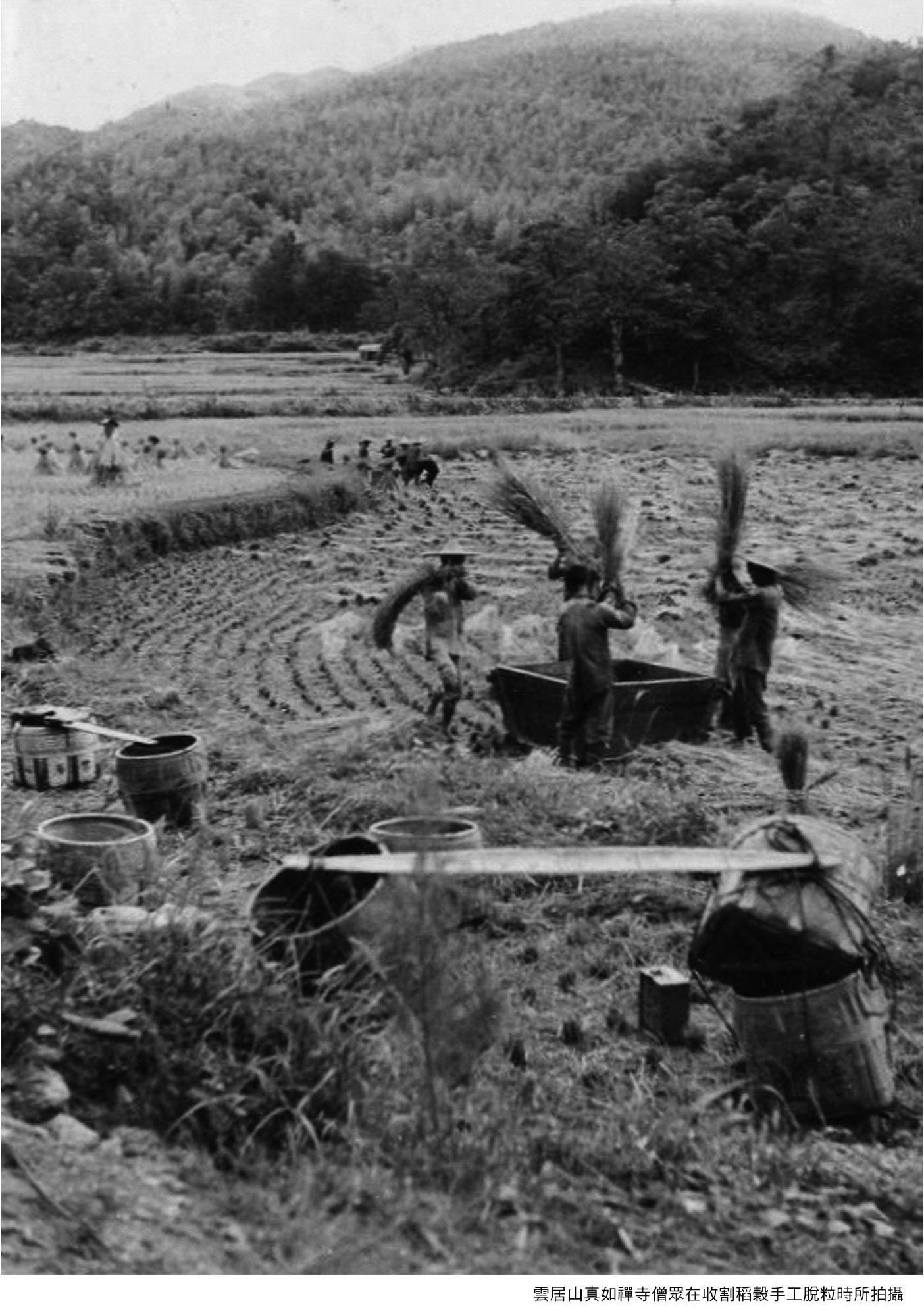
1955 真如禅寺 云居山 Cloud Abode Mountain. The farm.
At True Suchness monastery, our life was extremely hard and poor. Just to survive, an incredible amount of continual physical labour was necessary. In addition to farming, there were building projects for repairing the temple buildings. Despite this physical work, the daily chanting continued in the main hall without a break as did the meditation in the Chan hall. Empty Cloud would allocate an area of ground to clear for growing food each day. If the land was not cleared by the time the sun went down, we continued in the dark until it was done. Sometimes there were things to be dragged up the mountain at night with only the moon to guide us. The mountain track was ten miles long. This work often went on right through the night and barely finished before temple life started early in the morning at 3.45am. Because of this our sleeping time were often quite short.
“When the crop was planted two people would stand guard over the millet fields for two hours at a time. This was to stop the wild boar from ransacking the millet fields and eating the crop. At that time wild boar and tigers were common in the area. When the millet ripened, the wild boar would gather together into large groups and go there. Despite Empty Cloud being so old and respected, he always went to help guard the field. Master Hai Deng (later abbot of Shao Lin Monastery) was in charge of co-ordinating work on the mountain at that time and he did not like to see the old Master working so hard so he would turn up for guard duty and take over.
During the ‘Cloud Gate Incident’ (1951-52) the Master had had a number of bones broken and from 1956 to 1958 he often suffered from a fever and suffered localised pain where the breaks had been. He would lie on his bed moaning from the pain. However, whenever he had visitors he would sit straight up, cross his legs and greet them respectfully. He would sometimes talk with them for three or four hours. In fact, he often spoke for so long that we would have to ask the visitors to leave so that he could have a rest. When this happened the Master would scold us, saying, ‘People have come to see me, how can I ignore them?’ When the guests left, he would lie down and moan from the pain again. We asked him how it was that when people came to see him he appeared to have no pain. He said, ‘This is simply the burden of my karma determining whether I can get up or not.’ We were surprised to hear this.


