The Masters Last Year
Masters 120th year. 1958- October 13th 1959
In 1958, China was in the midst of socialist reformation & chaos, the post had stopped arriving. The abbots of China’s main monasteries were summoned to a political meeting and pressured to testify against Master Empty Cloud. They refused and only just escaped with their lives. Ultra leftists used this time to cause all kinds of trouble in the country. Master Empty Cloud had become a target. However, as he was a member of the National committee, he could not be directly or openly accused, so the activists set about trying to slur his reputation. This they did in a number of slanderous ways, accusing him of all kinds of bad behavior including homosexuality in his cow shed. Soon after that, at South Flower, Cloud Gate and True Suchness monasteries, posters were pasted to the walls accusing Master Empty Cloud of all sorts of things. He ignored them and told others to do likewise. Some of the Master’s closest students were then ordered to leave Cloud Abode Mountain and were sent to separate places. Then Master got a letter telling him that the charges against him had been dropped. He was lucky because he could have met a terrible end. The allegations had been laughed at by those in high government positions who knew him; one of them was even his personal student. Throughout this experience Master Empty Cloud remained calm and polite, but in his heart there was a sadness that could not be expressed in words.
Then, one day later, he heard that General Li, who by then was the last official supporter of Buddhism in the Communist Government, had been sacked and moved away from his post. He then heard he had died and he said to us, “I also will soon have to leave.” We were sad and asked, “Why does the Venerable Master want to go now?” He answered, “You do not yet understand. There will soon be ten years of strife in China that will cause untold suffering”. We did not understand him at that time, but soon afterwards came the Cultural Revolution of 1967 to 1976.
Meanwhile, his students around the world were celebrating his age. He told them not to send presents and that he was still sad about the death of his mother when she had given birth to him. The Bright Moon Pond was not finished so he personally got the job done. His students in Canada had offered money to build a Stupa for keeping the relics of the Buddha and old masters. This was completed in August and was the last building work he did. At the same time money came from Hong Kong and Canada for two Ksitigarbha Bodhisattva statues. They were completed in two months and were the last he ever commissioned. One was placed in the bell tower and the other in the new Stupa. By this time the ten mile track up to the monastery had been widened and all of the bridges rebuilt.
By July, the Master had become so weak he could no longer work. He had terrible indigestion and could only eat some thin congee at breakfast and lunch. The central government asked the local government to get him medical help but he refused. He was so ill that the Abbot and senior monks came to see him in the cow shed. He told them that it was thanks to the special affinity between them that they had restored the monastery so quickly and easily. He said he would soon die and asked them to look after the monastery for him. . In September, he recovered a bit and students came from Hong Kong for long talks with him. Then, on October 12th at lunch time the Master asked his attendants for the Buddha statue in his room to be removed. They told the Abbot and senior monks and they came to see him, asking him to stay inthe world a bit longer. He told them to stop taking such a worldly attitude and go to the main hall and chant the Buddha’s name. Asking for some last instruction, he said, “I have already told you this. There is no need to go through it all again. You are all tired so now please go to rest”. It was then midnight. On October 10th, 1959, the old monk wrote his will. It said, “My last words of instruction are to advise you all to work towards overcoming greed, hatred and delusion. To achieve this, one should practise discipline and meditation to generate wisdom and compassion. With good thoughts, a pure mind is created. You should cultivate an attitude of fearlessness so as to inspire the whole world”. He then advised us to follow the precepts to be sure of a good practice. He also asked them to put his yellow robe on his body when he was placed in a coffin.
On October the 12th the master had a visit from a few people demanding to know which monks supported the new government & which were against it. The master dared not answer them because of what the consequences might be, so he asked for some time to think about it. At lunch time on October 12th, 1959, he told one of his attendants that he had just had a dream during which he saw an ox trample on and break the Buddha Seal Bridge and he had witnessed the stream stop flowing. He then closed his eyes and was quiet. At 12.30pm he called his attendants to him and said, “You have been with me for many years and suffered any hardships on my behalf. I am deeply moved by your example. Although there is no point in digging up the past, it is true that for the last ten years I have suffered extreme hardship and slander to protect the true Dharma. I have risked my life to protect the Dharma. As my close disciples you know the truth of this matter. Whether you live in thatched huts or travel to other monasteries, you should keep this Sangha robe as an expression of our faith. How should the Dharma be preserved? In a single word, it is ‘Sila’, That is, the Buddhist precepts or discipline”. He then brought his palms together and asked his attendants to take good care of themselves. The attendants, holding back tears, went to the next room to wait. Early next morning, Oct 13th, the two attendants saw him get up and drink some water and then they saw him sitting in formal meditation as usual, except there was a strange red mark on his forehead.
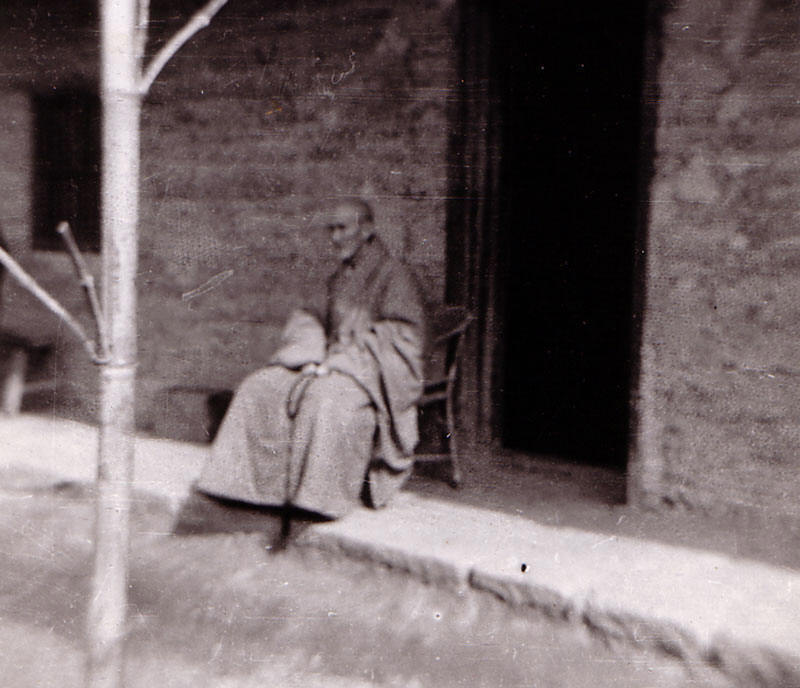
1959 at the Cow Shed 真如禅寺 云居山
At 3.30 am on the 13th of October, 1959, the two attendants re-entered his room and they saw that the Master had passed away peacefully. He lay there resting serenely on his right side just as Shakyamuni Buddha had done over 2,500 years before.


