On Pilgrimage to Five Peak Mountain
My Forty-Third Year 1883 – 1884
Pu To Shan 1985
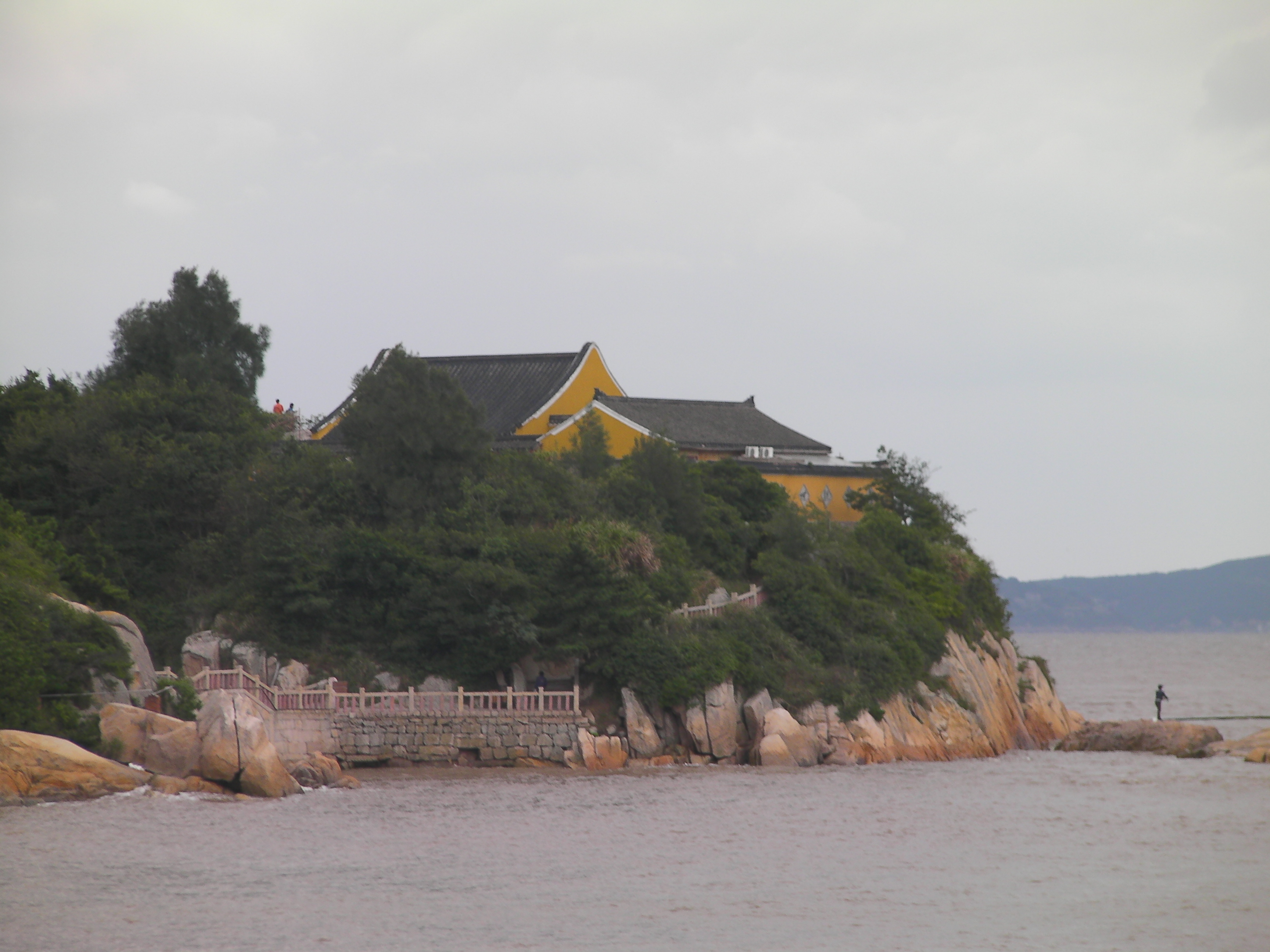
Pu To Shan 普陀山 near Ningbo. 2010
Having left my home, my family and two wives behind for over twenty years, it was embarrassing that I was still not enlightened. Feeling very ashamed of myself, I felt that I was in debt to my parents. As a way of repayment I planned a pilgrimage from Pu To Shan (Mountain Island near Ningbo, named after the Potala Palace in Lhasa, Tibet), on the east coast, to the Five Peaked Mountain or Wu Tai Shan (near Da Tong City), in the north of China. Having first arrived on Pu To Shan, I stayed for a few months, during which time my practice really got much better in that still and tranquil place. I left the thatched Dharma Flower or Fa Hua Dharma Flower Temple on the first of the seventh month, offering burning incense as I set off for the Five Peaked Mountain. This was done in a three step, one prostration type of pilgrimage all the way up north to Five Peak Mountain. I set off together with four other monks. We took the boat over to the mainland from Pu To Shan and arrived in Hu Zhou a few days later. At Hu Zhou and Chang Zhao the others went on their own ways and I proceeded alone. Arriving in Nan Jing, I went to Ox Head Mountain or Nui Tou Shan to prostrate at the late Master Fa Rong’s Stupa (a disciple of Faith Mind or Dao Xin, the fourth Patriarch of the Chan school). Then, crossing the river, I went on to Lion Mountain or Shi Zi Shan and passed the New Year in a temple at Pu Kou. My Forty-Fourth Year 1884 – 1885 I left Lion Mountain and went to the north of Jiangsu County. Holding incense all the way, I got to Henan County, travelling through Feng Yang, Hao Ling and Song Shan or Eminent Mountain where Shao Lin Monastery is located. Going on to Luo Yang, I arrived at the White Horse or Bai Ma Monastery. Whatever the weather, wind or rain, I walked during the day and rested at night. I chanted the mantra: ‘Na Mo Da Zih Wen Su Shih Li Pu Sa’, the homage to wise Manjusri Bodhisattva, and every third step I did a full prostration with a concentrated, focused mind. Thus, I detached myself from my hunger and cold.
On the first of December I got to the Yellow River or Huang He, passing the tomb of Gwang Wu or the bright warrier, and at the ferry pier I stayed at a small inn for the night. In the morning I took the ferry across the river and reached the other bank after darkness had fallen. I could not see to go on so I stopped the night in a vacant thatched hut by the side of the road and just sat there. It was an intensely cold night with a heavy snowfall. In the morning I opened my eyes to see that everything was under a foot of snow. There were no travellers as the roads were blocked. As I was now stranded I sat and did Buddha name recitation. I was freezing cold and starving hungry. The hut had no door so I sat huddled up in a corner. The snow got heavier and it got colder and I was so hungry. I only had my breath and right thought left! Three days later it was still freezing cold and I was starving. I started to lose my clarity. On the sixth day I glimpsed sunshine but had become very ill. After one week there, a beggar arrived and found me sleeping in the snow. He asked questions but I was unable to reply. He guessed I had hypothermia so cleared the hut of snow, removed some of the thatched roof and lit a fire with it, then cooked brown rice porridge (congee) and fed me some. I was revived from the point of death. He asked, ‘Where did you come from?’ I said, ‘From Pu To Shan.’ He asked, ‘Where are you going?’ I said, ‘To the Five Peak Mountain on pilgrimage.’ I asked, ‘What is your name?’ He said, ‘Wen Ji’. I asked him, ‘Where are you going to?’ ‘He replied, ‘To Xi An City. I came from Five Peak Mountain.’ I asked, ‘Do you know anybody at Five Peak Mountain?’ He replied, ‘I am known by everybody there.’ I then asked him the way. He said, ‘Go through Meng Xian, Huai Qing, Huang Sanling, Zin Zhou, Tai Gu, Tai Yuan, Tai Zhou and E Gou. You are then right on the mountain. When you get to Bi Mo cave, try to find a monk from the south called Primal Purity or Quing Ti , who has a deep and profound practice.’ ‘How far is it to the mountain?’ I asked. He replied, ‘Just over 2,000 li’ (about 620 miles). The next morning at dawn the beggar, using melted snow, cooked rice congee again. Pointing into the pot he asked me, ‘Do you have ‘THIS?’ (a koan) in Po To Mountain?’ Then, ‘WHAT do you drink there?’ ‘Water,’ was my reply. Once the snow had all melted he asked, ‘WHAT is it?’ (another koan) I said nothing so he asked, ‘What do you hope for with this pilgrimage?’ ‘When I was born I never saw my mother. I wish to repay the debt I owe her,’ I said. ‘It is so cold to be out with just a backpack and, with the distance, can you ever achieve this?’ he retorted. ‘Since I took a vow, neither distance nor time will stop me,’ was how I replied. He said, ‘This is a hard vow to accomplish. The roads are still all blocked by snow but, however, today the weather is getting better. Twenty li away from here is a small temple. You can follow my foot prints in the snow to there.’ He set off. The snow was too deep to continue my prostrations so I just mindfully watched where my feet were going. Then, safely arriving at the small mountain temple on Small Gold Mountain or Xaio Jin Shan, I stayed for one night. Next morning I set off again with incense sticks in my hand. Then I passed through Meng Xian. Later I was spotted by an old abbot named Virtue Forest or De Lin. He took my luggage and incense, gave them to his disciples to carry and invited me to stay at his Abundant Merit or Hong Fu Si Monastery. Whilst there, I was treated very well. We had tea and food, and then the old abbot asked, ‘From where did you start your pilgrimage?’ I said, ‘I made a vow and started out two years ago.’ Whilst telling my story my ordination on Drum Mountain came up. Crying out, he told me about his two ‘Dharma Brothers’ who came from Heng Yang and Fu Zhou. He told me, ‘Once we all went to Five Peak Mountain on pilgrimage and when we came back we stayed together here for thirty years. After they left there was no news from them. I hear your Hunanese accent which is just like ours. It makes me feel as though they have returned and I am deeply moved. I am eighty-five years old. We used to have enough income here from crops but it has been poor over the last few harvests. But, because of the snow, there will be a good harvest next year. You can stay with us, please, Venerable Master.’ He begged me really warmly to stay over the winter.
My Forty-Fifth Year 1885 – 1886
On the second day of spring I set off from Overflowing Merit or Hong Fu Monastery holding incense and resuming the three steps, one prostration practice for a day, returning to the monastery at night. On the third day I said goodbye to the old abbot Virtue Forest or De Lin who sobbed and was not at all happy at letting me go. I returned to Huai Ching that day. There was a place there called ‘Little Pu To’ or ‘Nan Hai’. Travelling monks were not allowed to stop there overnight, so I was forced to sleep on the side of the road outside town. That night I came down with stomach cramps. At dawn I set off again but was shivering with malaria. On the fifth day dysentery struck me, but I continued with my three steps, one prostration, regardless. On the thirteenth day I arrived at Huang Sha Ling and stopped in a ruined temple as I could go on no further and I had not eaten anything. I had terrible diarrhoea which ran out of me day and night. I was suffering from complete exhaustion and could no longer get up. Since I was in a remote temple on a mountain top, alone, I closed my eyes and waited for death, with no regrets. Then late at night on the fifteenth day, opening my eyes I saw someone lighting a fire under the west wall. First, I thought it must be a thief but soon realised it was the beggar Wen Ji. Happily, I called, ‘Wen Ji!’ He then lit a fire stick to light the place up and asked, ‘Why are you still here, Venerable Master?’ I told him my news and he gave me a cup of water, sitting closer to me for warmth and intimacy. I felt a holy purification on our meeting up again. In the morning he gave me medicine and washed my soiled clothes. On the seventeenth day I ate two bowls of brown rice porridge, sweated a lot and then recovered to a good degree, feeling a great happiness and contentment. The next day, the eighteenth, I was really on the way to recovery. Thanking Wen Ji I said, ‘You have saved me twice from danger. I do not have the words to thank you.’ He said, ‘It is nothing’. He told me he had been in Xian (Western Peace City), but was now going back to Five Peak Mountain. I said that I could not follow him because of my slow three step, one prostration routine. He replied, ‘This year you have not got very far. How long do you think it will take you in this weak state? You do not really need to carry on with this three step, one prostration pilgrimage.’ My reply was, ‘Thank you for your kind words. However, at my birth my mother died so I never met her. I was my father’s only son but I ran away from home. He resigned his important job because he lost face through me, which lead to his early death. I have had a guilt complex all my life. I felt that I could transfer the merit of this pilgrimage to them to secure their rebirth in the Pure Land of Bliss and Joy. I would rather die than fail, whatever the hardship and difficulty.’ Wen Ji replied, ‘Such filial piety is really quite rare. I am in no rush and I am also going to Five Peak Mountain so I will carry your luggage and we can go together. That way you can do the prostrations more easily, and collect your mind.’ I replied, ‘If I make it there, I will split the merit with you and just keep half for my parents to enable them to become enlightened as soon as they can. This is for saving my life. Will you accept?’ He said, ‘I am not worthy. I just happened to be passing by and there is no need to thank me.’ For the next four days, Wen Ji nursed me back to good health. I then took up his offer to carry my backpack. That was the nineteenth, and I resumed my three step, one prostration routine once more, though  I was still weak. However, my false thinking had at last come to an end. I noticed that the things around me no longer affected my right thought and with the passing of each day I got better and then I soon became strong once more. I went along performing the three steps, one prostration meditation, from dawn through to dusk. I covered about 45 li (15 miles) and that didn’t tire me. I arrived at Li Xiang Monastery in Big Valley or Da Gu on the thirteenth of the third moon (Chinese calendar) and by the end of the third moon I had reached Li Xiang Si (Left Mark). The guest master told me that the abbot was busy giving instruction to his monks. He looked us both up and down and asked me, ‘Who is this guy?’ I told him my story to which he snapped back in reply, ‘You ignorant wandering monk! You are so uninformed that you don’t even know we have a famine here! All over the north there has been a famine for years but you insist on going to Five Peak Mountain. Just look how important you are with your servant! Have you ever seen laymen like him being allowed to stay in Monasteries? Are you just out for fun? Then you needn’t wander about here!’ I didn’t want to square up to him so started leaving, making my excuses. ‘There are no rules to cover this. Nobody invited you, you just came according to your fancy,’ he snapped again. As he could not be reasonable, I asked, ‘Maybe I could just stay here then and the gentleman will go to a lodging house?’ and to this he agreed. As I could not get Wen Ji a bed for the night I took some change from my pocket and tried unsuccessfully to give it to him for his accommodation elsewhere, but he would not accept it and left. But then, suddenly, the guest master became quite friendly and took me to the guest monks’ quarters. He boiled water for some tea and cooked us thin noodles which we ate together. I was surprised at the change in him and, noticing nobody else was around, I asked, ‘Are there many monks living here?’ He said, ‘For many years I lived on the other side of the Jiang River, then I came back here to take care of this monastery. For a few years we have been in famine conditions. I now live here on my own. The only food we have is this type of noodle. Please don’t take what I said earlier seriously.’ I was very sad to hear what he said and had difficulty swallowing the last half of the bowl of noodles. I did not feel like staying even though he tried hard to keep me there. Leaving, I wandered the town, unsuccessfully looking for Wen Ji in the lodging houses there. There was a bright moon. It was the eighteenth day of the fourth moon (month) and I wanted to catch up with Wen Ji so I resumed my three steps,one prostration meditation once again, heading for Tai Yuan. However, I rushed at it and by the next morning had a continual nose bleed.
The next day I arrived at White Cloud Monastery or Pai Yun Si at Huang Du Gou. The guest master there saw that I was smeared with blood and reluctantly allowed me one night’s stay. Leaving there, I continued on, arriving early the next morning to suffer abuse and ridicule in Tai Yuan City’s, Absolute Bliss Monastery or Chi Le Si. On the twenty-second I left town early and then came across a young monk named Erudite Worthy or Wen Zian just outside the North Gate. He came over to me and took my back pack respectfully and treated me as though we were close relatives, inviting me to his temple. We went to the abbot’s room for tea and some food. During the conversation, I asked, ‘Venerable monk, you don’t have a local accent and you are under thirty years old. How is it you are the abbot here?’ He told me that his father had held an official post there but had been transferred to Bing Yang County where he was murdered by a corrupt official. He said, ‘My mother was upset, very angry and devastated but I controlled my emotions and left home life to be ordained as a monk. The ruling classes, whom I knew, invited me to take charge here. I have wanted to leave for a long time. You have inspired me and filled me with respect. I am inviting you to stay here and teach me.’ So I told him about my pilgrimage, which filled him with respect, and he insisted I stay on continually for ten days before I would leave. I was repeatedly refusing the new clothes and money he offered. When I did get away he came along for more than ten li, sobbing as we parted company. On the first day of the fifth moon, I was approaching Xin Zhou, prostrating every third step as usual. Then, a horse drawn carriage started to follow me so I moved to one side to give it enough room to get past. An army officer got out and asked, ‘Why are you going along here doing three steps, one prostration?’ I told him why I was on pilgrimage. Finding that we both spoke Hunanese and that he came from my home town of Xiangxiang, this led to a very pleasant conversation. He said, ‘I am staying at E Kou in Bai Yuan Monastery. You will be passing by there on your way to Five Peak Mountain. As you are doing this pilgrimage I would like to help by taking your back pack to make it easier for you.’ He took my things and as I was thanking him he left in his carriage.
Then it was easier for me to carry on. I arrived at the White Cloud Monastery or Bai Yun Si in the middle of the fifth moon. I stayed for three days with the officer at his headquarters. He tried to give me money as I left. I refused it but he sent somebody to carry my bag and to escort me together with some money to Prominent Connection Monastery or Xian Tong Si (The largest Monastery on Five Peak Mountain with 400 rooms, was built in the Eastern Han Yong Ping-year period AD 58-75). With incense in hand I carried on as usual to Bi Mo Cave on Gui Feng Mountain, then Lion Den Cave or Shi Zi Wo and the Dragon Cave or Lung Dong. All of these places had the most beautiful landscapes which were all quite beyond words to describe. However, as I was so busily engaged with the three step, one prostration meditation I didn’t really have much chance to enjoy the views. By the end of the fifth moon I went to Prominent connection Monastery or or Xian Tong Si to pick up my bag which had been left there by the soldiers. Then I went around the neighbouring temples to offer incense and I asked after Wen Ji. Nobody seemed to know him until I asked an old monk about a beggar. ‘He is a transformation of Manjusri Bodhisattva,’ he said and put his palms together and bowed. I made some prostrations in thanks. On the twenty-second I set off as usual with my incense and after two more days of the three steps, one prostration meditation, I arrived at Dong Tai. At last I had arrived at the first peak of Five Peak Mountain. It was a wonderfully starry sky and a bright moon lit the night. I took refuge in a stone temple and recited sutras and offered prayers and incense. Then I sat in meditation for seven whole days. After that, I went down from the peak to Narajana Cave, and ran out of supplies there. So, on the first day of the sixth moon, I went back to Xian Tong Monastery. On the second night I went up the Avatamsaka or Hua Yen Peak, sleeping the night up there having offered incense along the way. On the third day I went up on the North Peak, then slept for the night on the Central Peak. On the fourth day, I climbed the Western Peak to make offerings and sat right through the night engaged in deep meditation. Then on the fifth day I went back to Xian Tong Monastery. At that monastery, on the day of the sixth moon (month) there was to be a big prayer ceremony. So my vow for my parents was accomplished after three years. During that time, apart from Illness and extreme weather when I could not perform my three step, one prostration meditation or offer incense, I had achieved and maintained ‘right thought’ and ‘singleness of mind’. Each time I had run into problems I was but joyful. When I had had problems, after carefully looking into my state of mind, I found it was full of happiness. And the tougher things had got the easier my mind became. I could now understand what the ancients meant when they said, ‘We become bright by getting rid of old habits. Enduring strife, we realise some degree of enlightenment’.
There had been so many wonderful views along the route from Pu To Mountain, through Jiangsu, He Nan, The Yellow River and the Tai Hang range of mountains. It couldn’t really properly be put into words. Guide books give detailed accounts but you really have to go there yourself to understand how fantastic it is. There is the place where Manjusuri Bodhisattva sends out bright rays on Quing Liang on Five Peak Mountain. There are bottomless precipices covered in snow all the year round and there are stone bridges spanning them with caves as if looking out into space. This was all unique to this place. During the pilgrimage I had almost no time to enjoy the scenery but now I had finished I felt that I didn’t want the Gods of the mountain laughing at my childish inquisitiveness! When the Great Prayer Assembly had finished, I went and climbed up to Da Lo peak, paying homage there to the ‘Wisdom Lights’. On the first night there was no sign of them but on the second a big ball of light flew from the Northern to the Central Peak. After it descended it divided into ten balls of light all different in size. Then, later on the same night on Central Peak three light balls were seen going up and down, then four light balls of various size were seen on the North Peak. On the tenth day of the seventh moon, I gave thanks to Manjushri Bodhisattva, leaving the Five Peak Mountain range and then travelling north from Hua Yan orTurbid Source. I got to Da Ying or Great Camp just south of Hun Yuan. There, I went to Heng Shan or Eternal Mountain’s north peak, climbing up Hu Feng pass. There I found written on a stone arch the words, ‘The first mountain of the northern region’. Arriving at a temple where there was a forest of stone arches and steles with a flight of stone steps so high they seemed to climb to heaven itself, I offered incense before returning down. After that I went to Bing Yang County to visit the immortals, also the north and south caves. Emperor Yao (who reigned from 2357-2255 BC) had a temple to the south of Lin Fen town. It was a magnificent and imposing structure. Next, I went to the temple of the Han dynasty’s Prince Guanin at Lu Cun village in Pu Zhou County. Then, crossing the Yellow River, I walked through the Tong Guan tributary pass, into Shansi Province. From Shaded Flowers or Hua Yin I climbed Dai Hua Shan to prostrate at the west summit of Heng Mountain (One of the Five Taoist Mountains). I stayed there for eight days in the most beautiful of scenery. I had a feeling of admiration for Bai Yi and Shi Qi, so I walked to Shou Yang Mountain to the place where they are connected. Soon I found myself in Shansi County in the south west where I went to Avalokitesvara, Monastery or Kwan Yin Si on Incense Mountain or Xiang Shan. From there I went on to Prince Chuan Wang’s tomb, soon to find myself walking on to Gan Su County, passing Jing Quan and Ping Liang and arriving in Kong Tong Shan. It was almost the year’s end, so I returned to Kwan Yin Monastery on Incense Mountain, welcoming in the New Year there.


